
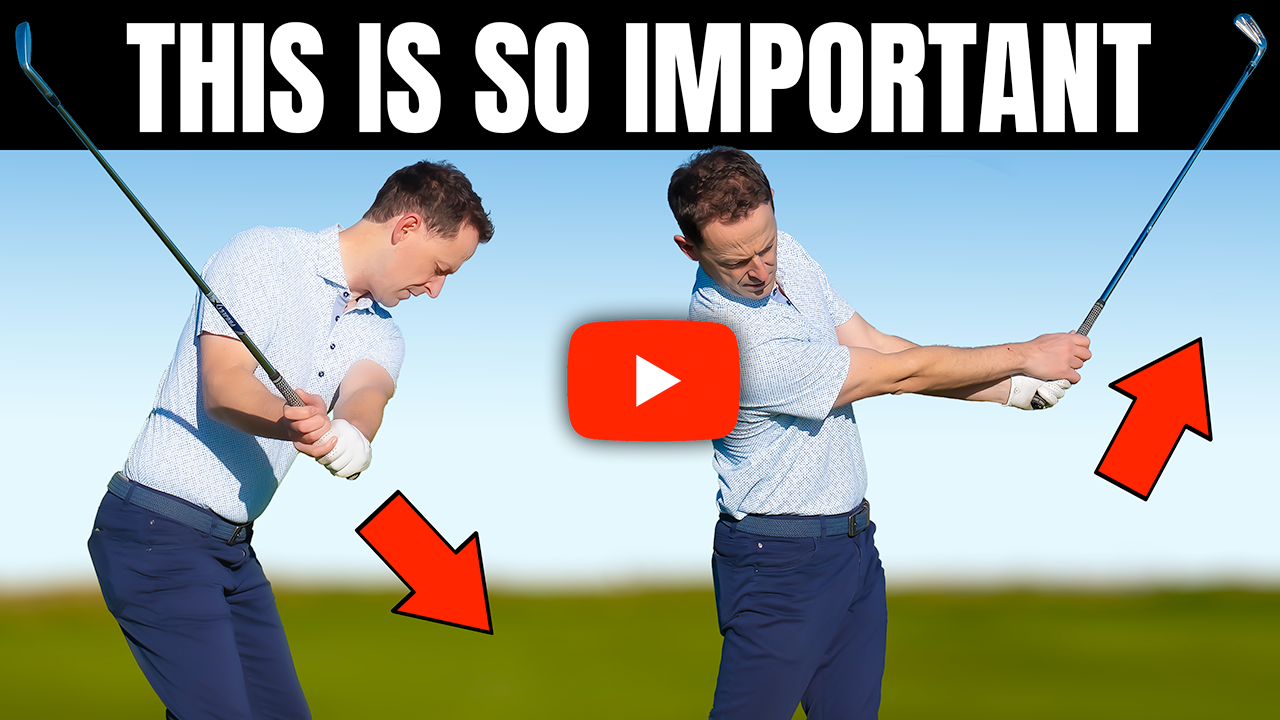
85% of Golfers Never Improve Because They're Not Taught This
Jun 02, 2026 Get This Free Practice Plan
Transcript Summary- So there’s one ingredient in the golf swing that I don’t think most golfers are really aware of. In fact, I’d go as far as to say it’s something many good players take for granted, because they’ve had it from a young age and it’s just become natural. And that ingredient is what I’d call educated hands — simply knowing what your hands and arms are actually supposed to do throughout the golf swing.
When I say “educated hands,” what I mean is having a clear understanding of how the club is meant to move through your grip, rather than just trying to swing with body positions and hoping the club follows. If you think about something simple like hammering a nail, your hands know exactly what they’re trying to do, and your body just supports that action. Golf is exactly the same. A lot of golfers struggle because they’ve never actually been taught what the hands and arms are supposed to be doing.
So let me give you a really simple way to feel it. If you take the club and hold it out in front of you, the first thing is to turn it into a proper lever system. From here, you’re not lifting the club randomly — you’re applying pressure through the grip so the club naturally sets and works around you. You’ll feel the right hand applying pressure, the club working into a structured position, and suddenly everything starts to feel more organised. The arms don’t just fly around anymore — they respond to what the hands are doing.
From there, in the backswing, the feeling is that the club is working up as a result of that pressure, not being lifted by it. You’ll notice the trail arm naturally supports that motion and sits into place, helping create a much more stable swing arc. Nothing is forced — it’s all connected through that simple idea of how the hands are working on the grip.
Then in the downswing, the feeling changes again. The lead arm starts to work down, the hands rotate, and the club naturally starts to square without you needing to manipulate it. This is the key — instead of trying to force the clubface square with your body or hands, you allow it to happen because the motion is already structured correctly. The thumbs feel like they’re working down, the forearms are rotating, and everything is moving in sequence.
What I often see with amateur golfers is the opposite — they don’t know what the hands should be doing, so the club just gets slung around or thrown out of position. Then they try to fix it with body movements, but it never really solves the root problem. Once you understand the hands, the body can actually start to support the swing instead of fighting it.
So I get players to rehearse it in a simple flow. You go back, feel that pressure in the grip, pause into a halfway position, then swing through into a controlled follow-through. When you do it properly, you’ll start to feel a real sense of structure and connection — and the ball flight often reflects that straight away.
And what’s really important is this: once your hands are “educated,” your body doesn’t have to guess anymore. It just responds. You’ll start to notice better timing, more consistent contact, and a much clearer understanding of what the club is actually doing. That’s when the swing starts to feel like it has coordination instead of chaos.
So give it a try. Don’t overcomplicate it. Just start by understanding what your hands are doing to the club, let your body support that, and over time you’ll build a much more reliable and repeatable golf swing.
Full Transcript- So there's one ingredient in the golf swing that I don't believe any, or barely any, golfers are aware of. And the reason being is, as successful players like myself and coaches, we took it for granted — or we often take it for granted. We start golf at a young age. We have this ingredient. It naturally makes us good. And then what we do is we go for lessons ourselves, work on various different body motions to improve our already good golf, because we already have this single ingredient just there helping us to perform at the highest level. Now this ingredient doesn't exist in most players. In fact, it's never taught. And what I want to do in this video is this. I want to share with you what that is because I believe all great golf comes from this one thing. It really, really does. Once I introduce it to you, you'll go, "That makes so much sense." So, I can't wait to share it with you. Before I do, though, look, if you're new to the channel, one of your first lessons of mine, please consider subscribing. I release videos just like this one every single week to try and help you improve your game. But you never have to remember a thing. Everything I do here, I'll put into a free download or practice guide that I'll pin to the top comment below this video, or simply just scan the QR code right there. So, what is that one ingredient? Educated hands. I know what my hands and arms are supposed to do during the golf swing. And that is what basically makes me a much better player than most people. I know what it's supposed to feel like. Now, what does this relate to? Because it's super, super important if you want to play good golf. If you imagine just grabbing a hammer and you want to hammer a nail into a piece of wood, you're very clear that the nail needs to go this way. What does the job? Your hands. You know that you've got to do this. You know what to do because you know what your hands are supposed to do to hammer the nail. What does your body do? It stands and moves and supports what the arms and hands are doing by standing like this, and hits the nail. Why do we see so many funky golf swings? Because golfers aren't doing what they're supposed to do with their hands and their arms — because they don't know. So what they do is they make funky swings because this bit doesn't work. They don't know what to do. So, in this video, I want to share with you exactly how your hands and arms work by sharing with you an unbelievable drill that my mentor Graeme Walker shared with me. So simple, but it really educates them very, very quickly. So, all I want you to do — and if you can grab a golf club with me, just grab one, pause the video, and just grab a golf club to learn this feeling. Okay? It's super, super simple. So, we're going to hold the club out in front of us here, just around about midriff height. Now, golf is a lever system. So, the very first thing I want you to do is this. I want you here to simply push the lever down to the ground here. So, you'll feel a pressure of the right hand on top of the grip pushing down here so that the club pitches just over your trail shoulder. Very, very important. So, two things have happened here. As soon as you in a sense push down the lever, you're already achieving something that most golfers never do. We're turning this club into a lever. Most golfers in the backswing lift the club into position here. This is not a lever. They get out of position. Why? Because they don't know how their hands are supposed to work. Look at this. Now it's a lever system. Now I've got structure. Okay. The other thing here, look — pressure on the grip. This now is really important. This is how the hands are supposed to work in the backswing. I'm educating them now. Look, as I know my hands are supposed to work like this in the backswing, notice what my trail arm does now. It starts to sit down a little bit. It's supporting very naturally what my hands are telling it to do as I swing back. And this happens very naturally into the backswing. My body now naturally is supporting what my hands are telling it to do. So I now form a beautiful swing arc in that backswing. There. Done. Right now, this is the downswing. What we're going to do now, look, is notice what my lead arm does here — down. What do you notice about the grip? It's almost facing towards the target. So, it's rotating downwards. What's my trail hand doing? Rotating downwards. My thumbs are working down to the ground. Fantastic. So now look, as opposed to closing the clubface by coming over the top like most people are doing, you don't need to do that anymore. We're going to be here. Look, the face is naturally closing down because now your hands are educated. So now, suddenly, rather than the body trying to do some funky stuff like this, we're educating it to do it correctly. Now the arms are working. Our body can support this motion. Does that make sense? We can now deliver this clubface square to the ball. We're not going to try and square it like this. Why? Because if we did this and this, that doesn't make any sense. We're educating how the hands are working in the backswing and the downswing. Now, this one was brilliant. This is actually why Graeme gave it to me personally a few years back because, look, as somebody like myself who hooks the golf ball, I would drive my handle too much here and then flick the club. Most golfers don't have any control. They're letting that club just fly away from them. They don't know what to do. So from here, look at this. Back, release. Now look at this. Keep the handle where it is. Look at my trail hand. Pressure there. Down. And now look. Hinge it in line with the lead shoulder. This would be, look — oh. So that's the destination we're moving towards. Right. So now look at the arms here. How they're working. One. Right elbow sits down. Coming back here. Look. And now look. Left elbow sits down. So this is how my hands are supposed to work in the golf swing. Not sling, sling, sling, sling. Now we know how they're supposed to work. Our bodies can support our arms, hands, and club. Does that all make sense? Because now I know I'm going to hinge this here and this is going to feel the pressure on this grip. My body's turning in such a way to allow it to happen. Knowing that the clubface is naturally closing on the way through, I don't need to try and close it like this. It's closing down. Now I know on the way through I can finish to a beautiful finish position because I know from here I am going to move up the arc here. My body will support that motion. So now suddenly we have a coordinated swing motion because our hands and arms are telling our bodies what to do next. So you can keep this nice and flowing. The first thing I would do — just do the drill a few times. Just educate yourself and you might start with your hands here. But notice basically my arms here. The right arm is going down. And look at my forearms now. They're kind of — left arm is above my right arm. It goes down. And then look, through — my left arm is now below my trail arm. Right? So now you know how the arms are working. You're not just slinging the club away and losing control. They are moving and controlling this golf club beautifully through. And now we can start to think, okay, what does my body do? Well, just allow the body to support what those hands and arms are doing. Make sense? Whereas too many times what I'm seeing with my students — they're working on the body without knowing what the hands and arms should do. So let's have a look at this in action. What I have to do with many of my students who struggle — we tend to do it one at a time, maybe backswing and downswing. But in an ideal world, I like the idea of just the flowing motion of those arms and understanding — rather than just look, the flowing motion of a club which could swing any old how — we're now supporting it with this. So we get ourselves set and what I'll do is I'll do one exercise where we go — one, hold. Very important. Look, we must keep that butt end on. This is the lever. When you do this, you'll feel a pressure in your arms. You really will. That pressure is important. It's telling your body what to do. From here, this is impact. And then look, this is halfway into the follow-through. So this is my destination. So now I'm going to imagine that and I'm going to swing through into impact and then back into this position here. So this is that follow-through position. So let's have a look at this. Feel that motion — one. And I'm just swinging the arms in as free a motion as I can. Let's have a look.
Beautiful little draw. Now I can do that every time. Why? Because I have the feel. Now, the great thing is, all I need to do is just trust my body to start to support that motion. And then all we're doing is trying to time it. So, let's say imagine, for instance, you've got the arms working beautifully well, but you might do what I did to start with and just move your body too far forward. Now, suddenly they're out of sequence with those arms. They have to catch up. That leads to flicky strikes, kind of hooky strikes for someone like myself. Now, I know what the arms are supposed to do. The idea now is that I start to time my body up with that. So, this would be too out of sequence. I'm going to have to do this. Most amateur golfers would be the opposite. They would — you might get the arms working, but you do this. So, you need to get the body working with those arms a lot more. So, they're now more in sequence, more in timing. But all of that naturally starts to happen once you understand what they're supposed to do. One more. So, drill one. Feel that pressure. Follow-through. One, two. Feel the flowing motion.
And I felt there a little bit mistimed. Look at that clubface — first face first to pass. Just a little bit closed. I felt there I got a little bit slidey. Caught it up at the end. But this is the thing — because I know what my hands and arms are supposed to do, I can feel that difference, and my body not supporting what my hands and arms are supposed to do. That gives me the feeling and I know what to do when I'm on the golf course to correct it. You will start to do this too once you start to understand this bit. This is your GPS of the swing, and let your body support your arms, hands, and club. So go and give it a go. Really educate what those hands and arms are doing and just have some fun. Let them teach your body what to do next. Like I said, people like myself in my early years of coaching, I took it for granted. I need you to play around so that you have control over that golf club. More importantly, you have feel over your hands, your arms, and your body will just learn. All right, hope you enjoyed the video. If you did, give it a thumbs up. Maybe share it with one of your friends. And of course, look, if you're new to the channel, press that subscribe button somewhere around here. Once you've got your hands and arms going and you want to know how to support that with a wonderful body action, check this video out right here. And if you'd like to have more personalised lessons from me, head on over to dannymaude.com. But until next week, have a wonderful golfing week.
