
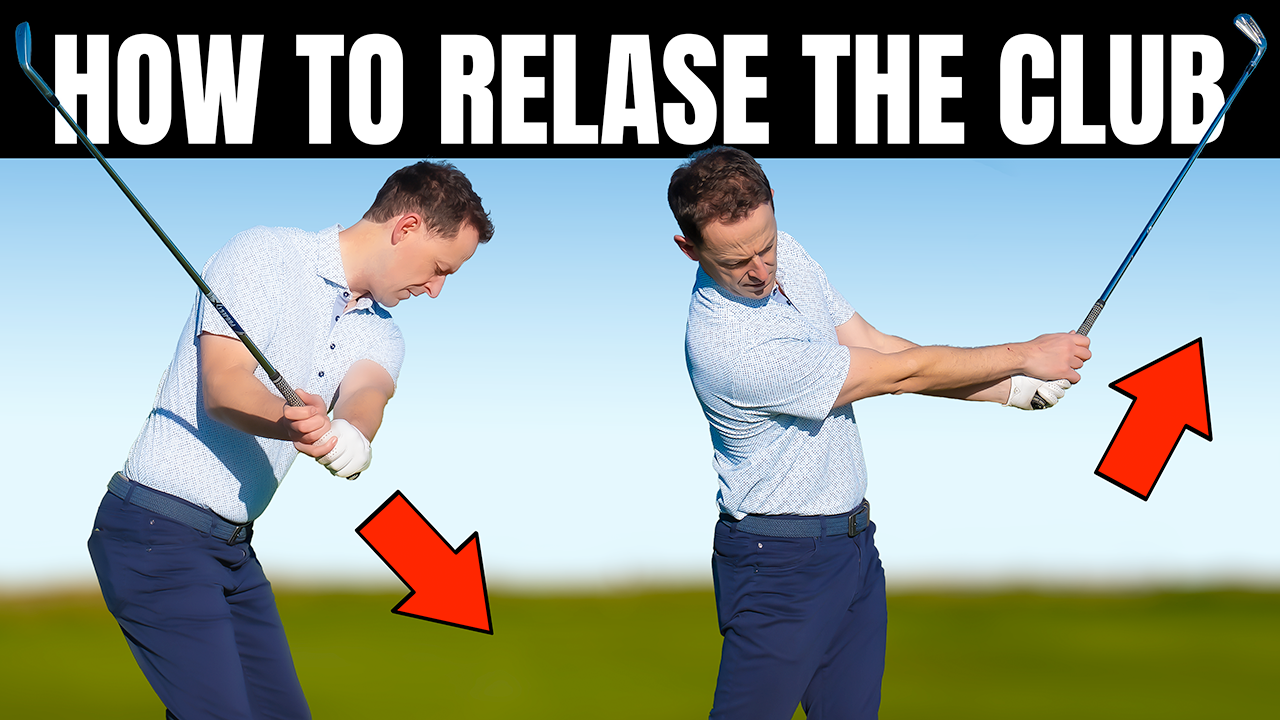
Always Release The Club Like This (It's Like Cheating)
Jan 05, 2026 Get This Free Practice Plan
Transcript Edit -
How you release the golf club — whether it’s with your irons or your driver — will ultimately determine how accurate you are and how far you hit the ball. Now, what I see all the time on the lesson tee are golfers trying to hold lag, trying to get that compression with their irons, keeping the shaft leaning forward — all in the name of control. But what often happens is, in trying to control it, they actually lose all that effortless power.
So, in this week’s video, I’m going to show you a really simple way to release the golf club that not only helps you stay accurate but also allows you to generate effortless clubhead speed — just like the pros do. You’ll create that smooth, easy power in your golf swing without losing control.
Before we dive in, if this is your first lesson with me, welcome! I release videos like this every single week to help you improve your golf, and you never have to remember a thing — I always include a free downloadable practice guide in the description below.
Now, I think you’re going to love this one. It’s going to help you hit the ball longer, but more importantly, it’s going to feel easier to do. We’re going to start by showing you how the arms work to properly release the golf club — both your right arm and your left arm. Then I’ll show you how to control that speed with one simple body motion. And finally, I’ll give you a quick tip to help glue it all together so you can take it straight to the golf course.
Let’s start with the arms. We want a free-flowing golf swing. The arms aren’t there to steer the ball or hold angles. We don’t want to hold that lag or try to trap the ball — we want to release the golf club fully to maximise your potential distance, no matter your age.
Here’s a great feeling to start with: grab your lead tricep and pin it gently to your side. That just locks your elbow in place. Now, simply allow the club to swing freely. Notice how your arm moves around the joint of your elbow — it works up and then down, nice and naturally. You’re not pulling it around, you’re not forcing it — you’re just letting it move freely. When you do this properly, the arm naturally turns as it moves — that’s the start of a proper release.
Do the same with your lead arm. Pin it in, and just let it swing back and through. You’ll notice your lead arm works in a similar way — up and through, freely flowing. You’re not steering it, you’re not guiding it. Just let it pivot around that elbow joint.
Now, if we stopped here, we’d just have a lovely release but no power or control. So the next step is learning how to organise the body so that this release happens in the right place — through the ball.
Here’s where most golfers go wrong. When they start to release the club freely, they spin their pelvis too early — the backside moves backwards, and the upper body falls away from the target. That causes an early release, a flick at impact, and often a weak slice or a pull.
What we want instead is to keep that pelvis slightly forward as we release. That allows the club to flow freely through impact with great compression — just like the pros.
One of my favourite little training aids for this is what I call the “shin breaker.” Awful name, I know — but don’t worry, it won’t break your shins! All you do is place your foot just inside the basket or stick setup. It gives you feedback. If you spin too early or slide, you’ll bump into it — but when you move correctly, your pelvis stays forward, allowing you to fully release the club and strike it beautifully.
So, to summarise those two steps:
-
Work on freeing up your arms — let them release naturally.
-
Use something like the “shin breaker” to train your body motion so the pelvis stays forward through impact.
Once you’ve got that, you’ll start to feel that effortless clubhead speed while still compressing the golf ball beautifully.
Now, before we finish, let’s talk about how to glue it all together. You might be releasing beautifully now, but some of you will notice that the ball still starts offline — maybe the clubface is open or closed through impact. That’s where awareness comes in.
With my students, I use a HackMotion sensor to help them feel where the clubface is at the top of the swing. If the face is open there, no matter how well you release it, it’ll still be open when you hit the ball. The HackMotion gives you instant feedback — so when you swing to the top and then release freely, you know that face is in the right place every single time.
It’s such a simple fix, but it’s a game-changer for consistency. And HackMotion have kindly given me a huge discount for all my subscribers — just check the top comment for the link.
So there you go — two key steps to creating that free-flowing, powerful release, and one final tip to make sure your clubface is under control. Put all of this together and you’ll start building that effortless, natural golf swing you’ve always wanted.
If you found this helpful, give it a thumbs up and maybe share it with a golfing friend who’s looking a bit too stiff or controlled in their swing. And when you’re done, check out this video right here — it complements this one perfectly.
Have a great week, and as always, I’ll see you next time.
Full Transcript- How you release the golf club with your irons and your driver will determine ultimately how accurate you are, but more importantly how far you actually hit the shot. What I'm seeing day in day out on the lesson Tee are golfers trying to hold lag, trying to get compression with their irons, trying to keep that shaft leaning forward, and they're doing a lot of things that are trying to add natural control to the golf club, but they rob themselves of so much effortless power. In this golf video, what I want to do is I want to show you really simply how to release the golf club in such a way that does obviously one thing, keeps you on the straight and narrow, but how it generates I want you to basically generate some effortless club head speed here. So like the pros do, we can create this easy golf swing without losing control. It's super super important to understand. Before I do though, if you're new to the channel, your first golf lessons of mine, please consider subscribing. I release videos like this one every single week to try and help you improve your game. You never have to remember thing. Everything I do here, I'll put into a free downloadable practice guide in the description box below. So, I think you're going to love the feeling this gives your golf swing. It's going to certainly help you hit it the golf ball longer, but more important, it's going to feel easier to do. So, we're going to start by showing you how the arms work to fully release this golf club, both your your right arm and your left arm. Then, what I'm going to do is once you've generated some effortless club head speed, I'm going to show you how you control that speed with one simple golf tip for the body motion. And then just little simple golf tip at the end, how you glue all this together and take it to the golf course. So first of all, we want a free flowing golf swing, right? How do we create it? How do the arms work to do that? They do not steer the ball. They do not try to hold angles. We do not ever try and hold the angle and try and compress it. We always want to be releasing this golf club completely fully to maximize your potential distance no matter what age you are. So here's how you do it. The first feeling, my favorite exercise I would say, grab your lead tricep, pin it to your side for a second, right? What I'm going to do, this just locks the elbow in place. Now all I want you to do is allow the club just to swing. Now, as I'm doing this, notice how my arm moves around the joint of my elbow, and it simply just works upwards. I aren't pulling it around. I'm not moving my arm. I'm not allow my arm just to swing like this. I'm letting it look move around the joint. And because it moves around the joint, that's all my arm can do. It simply just works up. And then, look, from here, releases back down again. Up, down. Notice how my arm naturally turns to the left and turns up to the sky to the right. Simple as that. So, get that sensation. When people do this for the first time, they allow this arm to do this because they're not used to pivoting around this joint. They try to move their arm. No, it works up and naturally releases down. No control whatsoever, please. Right. This is why I often serve my students. They'll go like this and then they won't let it go. Just let it free fall. This is one of the big secrets to I suppose consistency, right? So once you've got that sensation, the arm goes up and falls down. Simply reverse that with your lead arm. Lock it in. Same principle here. Look, I'm simply going to swing backwards in a free flow motion. And now it's on the way through. I aren't doing this. I'm not guiding it. I'm not steering it. I am allowing the arm to simply pivot around the elbow. And you'll notice it simply works upwards like this. Right? And notice it's just freely flowing. So the you can see the back my uh the top of my palm faces the sky here. And as I fl um in a sense kind of let it flow, it almost feels like it's pointing downwards to a certain degree, right? But I'm just freely flowing this golf club. This is how your lead arm and your trail arm work to freely flow the golf club. But if I just did this in a swing without using my body, we would have a flick and a very poor strike. So we've got to how do we naturally get into a beautiful powerful position while we are consistently flowing like this? Flick of the ceil with the right hand up. If I don't move my body correctly, I'm just a beautiful release of the golf club, but it's happened in the wrong place. I need to move my body so that when it does happen, I am creating the right compression and strike on the golf ball. But that is step number one. So step two is how we start to learn to control the club. You might feel as you're doing this, it feels completely out of control. Good. That is the what it should feel like. It should feel like it's free and flowing. And you might even feel a bit nervous that how am I going to hit the golf ball from here? Just go with it. We want a free flowing club. Let's organize the body. Now, so I'm going to I've just got a stick holder here. Now, this is super important. So, this is the number one thing I see with amateur golfers who tend to slice the golf ball or struggle with distance. What happens now is this. They move this club. Now, the after swinging it freely. Now, what happens is this. They start to from here spin their back side or their pelvis backwards. Well, if I do that and I release the club, I'm obviously going to release it look early and now I'm going to get into this what we call flip or flick territory into kind of slice territory as because I'm falling backwards, right? So, but if we were able to keep the pelvis staying forwards as I do this, notice the difference. I'm releasing the club that it goes through to a beautiful impact position and of course then releases beautifully through. But if I fall backwards, which is what I see with a lot of players, you'll see this heel start to drift back and yes, I'm free free releasing, but suddenly the ball goes left with a big pull. So then they go, I don't like that. So then they start to steer it. Chicken wing comes out to kind of hold the face and then just to try and get it into the fairway. So what they do is start to manipulate it and they think it's lack of control here when it's just an incorrect use of the body. So you've got the stick holder to give yourself feedback, right? So what we actually want to have happen here is one, the pelvis stays ahead of the stick on the way down so we can completely freely flow this club. But this is one of my all-time favorites. Awful name. It's called a shin breaker. Full disclaimer, I no responsibility for breaking shins, but no, it won't break your shin. But basically, you put your foot inside the basket here. And the idea here is is you've got this free flowing motion of the golf club. But what I like about it, it's like a little constraint, something that's just bit it's going to give you catch your attention. Most people, like I say, they do this. They move too much this way into the golf ball. That spins them out. And if you have a free flowing release, of course, you're going to release it too early and you're going to flick it left. and then suddenly you're going to have to kind of chicken wing it out to hit some straight shots. What this does naturally, look, is as opposed to this, it helps me keep the pelvis naturally forward so that when I come into the golf ball and I'm fully releasing, look, I get the shaft that I want without trying yet I've got a full release of this club. All right, so it looks something like this. Get yourself set. Here we go.
And you can see here, look, my leg look is kind of like banked inwards. And that allows that pelvis to stay forward and fully release the club, right? Helps you naturally create compression. And it's going to help you create that beautiful strike. So before we work on the thing that glues all of this together, what I want you to do is practice with it. You want to focus on your right arm, your left arm. really practicing what a free release of the golf club is. Yeah. Then put the shin breaker in as as such. Right. Make sure as you're doing this, you can then get that sensation look of a free flowing club. That's training my pelvis to work correctly. You could do the same with your lead arm. Get that sensation. Hit a few shots. No attempt to try and control that club whatsoever. Let's finish off with what very, very important point. How do you glue this together? So, I think those first two steps are going to give you this lovely natural motion. It's going to feel great. The chances are now if you keep working on those two two steps, your strike's going to improve, your distance is going to improve, and your direction will start to get better and better. However, one thing that often gets in the way of this with some of my students, just some, is where this club face is in your control. You could be freely flowing this glove club through the shot, but how do you make sure that the club face isn't wide open when you're releasing in the club? How do you make sure it's not closed? How do we make sure that it stays reasonably straight as it's flowing through the shot? Well, you need to develop a sense of awareness, and that's not always easy. So, what I do with my students, I give them just I use Hack Motion, and I give them a sense of where that face is in time. It's not always easy to see. So, all we do, we get themselves set up here. And once they're in this address position, I get them to swing to the top. And if that face is open, it's going to give a kind of a pretty not very nice sound. Then, oh, now when the club's in a great place, it allows now the increased likelihood that when you beautifully freely release this club, it's going to be exactly where you need it to go. If the face is wide open in your golf swing and you try to release it, the chances are it's still going to be reasonably wide open when you actually go and hit that golf shot. So, keeping this free flowing motion, but developing awareness of where the club face is. No, there we go. I can now start to kind of trust that when I do release that golf club, it's going to be in the right place time and time again. It's super simple, but obviously when you get to the top of your back swing like this, I can't see that, right? So, I need to be able to have some feedback as to where it is. Hack Motion does that. So, let's finish off with one shot. And while I do, just to let you know, HackMotion have kindly offered me a very large discount for any of my subscribers in the comments box below. So, just check out the top comment and you will be able to be directed to one of the biggest discounts they have done to date.
Pretty good. All right. So, grab those first two steps, work on them. Let's together now start to build this beautiful effortless motion where you feel free, it feels natural, right? And then obviously, you know, if the if it's still going a little bit a ride, just check that club face. Maybe use a device like Hat Motion to check where that face is. I hope you enjoyed the video. Give it a thumbs up. Maybe share it with one of your friends who you see looking a little bit wooden, a little bit controlled. Hopefully, this will help them, too. What I'd love you to do now is check this video out right here, which complements this absolutely beautifully. But until next week, have a wonderful golfing.
