
If Your Struggle To Strike Your Irons, Just Do This Before Every Shot
Aug 19, 2026 Get This Free Practice Plan
Transcript Summary-
If you’re struggling to strike your irons consistently off the ground—sometimes fatting it, thinning it or even topping it—you need to understand one really simple principle: you have to strike the ball before you strike the ground.
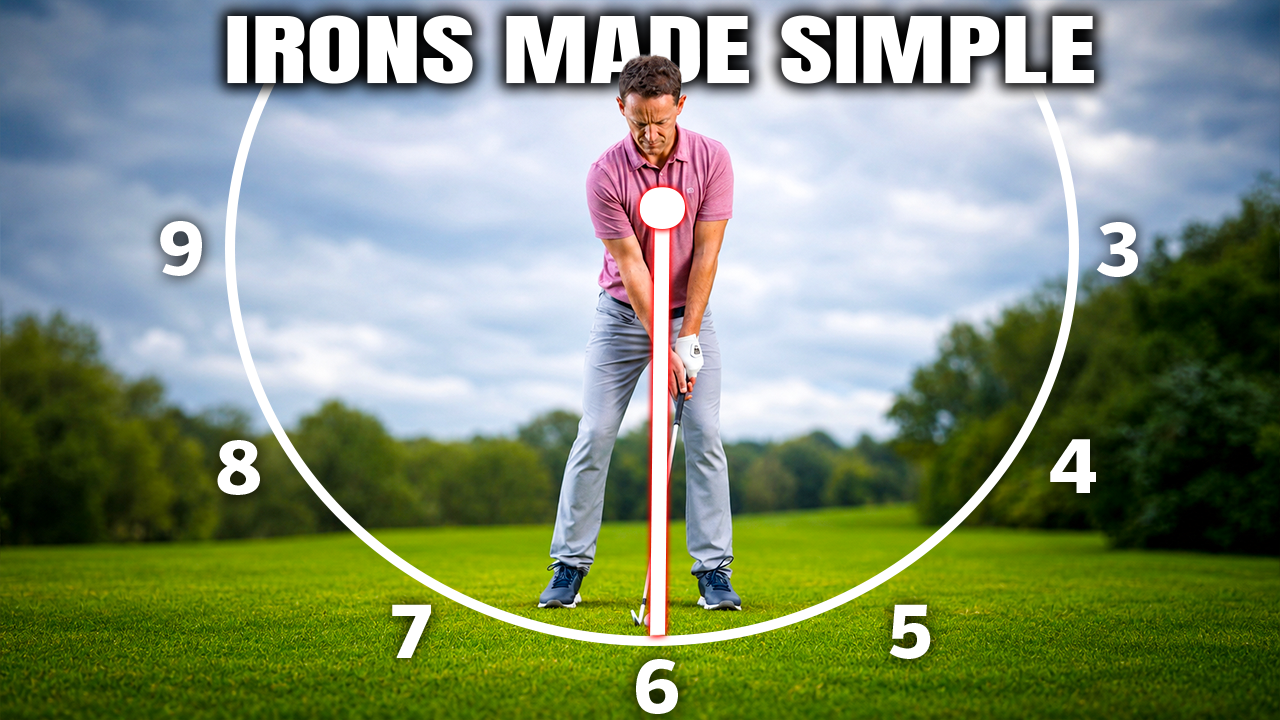
The key to doing that consistently is controlling the bottom of your swing arc. Think of the swing like a clock. The bottom of the arc needs to happen around 6 o’clock, but importantly, it needs to happen ahead of the golf ball, not behind it.
The first thing I want you to focus on is your weight and your chest. If you move your weight and your chest towards your lead side, you make it much more likely that the bottom of your swing will happen ahead of the ball. If your chest moves backwards, the bottom of the arc moves backwards too, and that’s when you start seeing those fats, thins and tops.
But there’s another really important piece to this, and that’s the trail arm. You can have your weight and chest forward and still hit the ground early if you release the club incorrectly.
What we see with a lot of golfers is that the trail shoulder stays too high and the trail arm straightens too early. It’s almost like they’re throwing the club straight down towards the ground. When you do that, the bottom of the arc happens too early and you end up hitting the ground behind the ball.
Instead, think about skimming a stone across water. Your trail shoulder stays lower, the club works around you on an arc, and you release it around the corner rather than throwing it straight down. This allows the club to stay behind you for longer before it naturally releases through the ball.
So there are really two simple checkpoints. Keep your weight forward and your chest forward, and then imagine you’re skimming a stone around the corner rather than throwing the club down at the ground.
When you combine those two things, you make it much easier to get the club moving through the ball on the correct arc and strike the ball before you strike the ground.
And remember, ball position matters too. For most iron shots, having the ball around the centre of your stance is a great starting point. You don’t want it creeping too far forward, because that can make it much harder to get the low point ahead of the ball.
So if you want more consistent iron contact, don’t overcomplicate it. Weight forward, chest forward, and feel that sidearm, skimming-the-stone action through the ball.
That’s one of the simplest ways I know to start striking your irons much more consistently.
Full Transcript- So, if you're struggling to strike your irions consistently off the ground, maybe sometimes you fat it, sometimes you thin it, sometimes you top it on the ground, and you want something super simple to guarantee more consistent contact, this is the video for you. So, what I want to do is this. You need to understand there's only one real technique to strike your irons consistently, and that is simply this. You've got to touch the ground after you struck the ball. So, you need to strike the ball before you strike the ground. But how do you do that on a consistent basis? You need to understand how to control the bottom of your swing arc. So, if I take a club like this and I just take it in my lead hand here and this lead hand now is swinging. This is I'm going to class this as six o'clock on a clock. And if I just swing this back, you can see how my lead arm, the club here works up the clock. It works down the clock and it bottoms out at 6:00, which in this situation, look, would be ahead of the ball, which is great. It touches the ground ahead of the ball, which is important. Then it works upwards. Okay. So, if we're able to control that, you're going to be able to make much much more consistent uh contact. The problem is when we put the right hand in or the trail hand, look what happens now. I haven't changed anything. But now, suddenly 6:00 on the on the clock here is on this side of the golf ball. So, when I make a swing now, the club works up the clock here. It works down the clock and bottoms out. Look, behind the golf ball and then it starts to come upwards. Now, if we hit a ball like that, what would happen? The club would start to work, hit the ground behind the golf ball, start to work upwards. Now, that would be your thin shot. Or we could strike the ground quite deeply there, and that would be your fat shot. Make sense? So, we need to figure out how to using both arms control where the bottom of the swing is. So, there's two phases to this. We'll second phase, we'll talk about the the right arm. Very, very important. Nothing works without controlling that. But the simple thing to do initially is this. I want you to look at where the middle of my chest is relative to that golf ball. I want to make sure we want to strike this side of the golf ball. So, where should this chest be? What would increase the likelihood that we're going to strike the ball before we touch the ground? If we move our weight forward, look at this here. If I've got maybe 70% of my weight, look, over on my lead side, I am going to strike the ground where see that comfortably ahead of the golf ball. If I have my weight more over to my trail foot here, I'm more likely to strike over here. So, the very first thing I want you to do is simply push your weight and your chest over this side of the golf ball. That is it to start with. Move your weight forward. Keep your chest forward and pay attention to where your chest is through this swing. If you start feeling your chest going backwards, that will likely lead to those fats and fins and top shots. But if my chest stays forward along with my lower body, I am more likely to touch the ball before I touch the ground.
And just take a look at that. That's where the ball was. Come and have a look at this. You can comfortably see there's the ball. And where have I stuck the ground? The lowest point of the ground. Look there, the contact is look ahead of where the ball was. Now let's show you what naturally happens if and many of my students do this. They struggle to get the ball airborne and now suddenly start to do this.
My chest has gone backwards. Now take a look at this. There's the ball. Where's the divot? Way behind. So, as soon as we start to move that chest forward, you increase the likelihood that you're going to strike the golf ball. Now, before we work on the right arm here, which is unbelievably important, if you don't know how to control this, having the weight forward and the chest forward on its own won't work. But what you can do, if you haven't already, check out Swing Coach, uh, my new app, and see where you are. Where's your chest relative to that golf ball? Is it forward of the ball? Fantastic. that's going to increase the likelihood that you're going to strike the ball uh first or have you got it hanging back? Some people feel like they've got it forward, but swing coach will identify exactly what your problem is. If you're interested, I'll put a link. I'll scan a QR code right here for a 14 uh week free trial at the moment. It's just for Apple users. Unfortunately, we're going to try and get Android sorted. If you if uh you can try it out, check for yourself for 14 days and then just simply cancel if you want. Right, you probably won't. Now, let's have a look at the right arm. So, you're paying attention now to where your chest is and where your weight is, and that's going to increase the likelihood that you're going to strike the ball first. However, the golf swing is an arc, isn't it? Now, here's the problem. Watch what happens here. This is what we notice by tens of thousands of golfers on the Swing Coach app. When you're swinging, most of the time, what's happening here is this. People are swinging with their right arm and this shoulder stays very, very high. And if it does, what happens is is the arm gets straightens too early. It releases the club as if they're throwing a club or throwing a ball down to the ground here. If you do that, look, 6:00 happens way too early. And now suddenly we start hitting up on the golf ball. That's your fats and your thins. So what should we do instead? Well, let me show you technically what happens. Then I'll show you very easily how you naturally achieve it. So the best players are able to do this. when they're coming down here, this trail shoulder stays low here and it works look on an arc and it's this arc here that keeps this club naturally hanging back before it finally gets released around the corner to strike the golf ball. The best way to imagine this is like skimming a stone along a pond. If most people what I'm seeing here when they're swinging, they look like they're releasing the club way too early. Why? because it looks like they're throwing a ball down to the ground as if it was going to bounce straight back up at them. Golf here, this is important. Golf is played on an arc. It's not played on a straight up and down. It's played much more on an arc. So, look at this. If I'm going to skim a stun along a pond here, look at the difference here. Look where my right shoulder is here. It's low. This is helping me not naturally, by the way, not release this arm too soon. I'm releasing it on an arc here. Now, suddenly, look at this. Now look, I'm able to pivot. I'm able to keep my chest ahead of the golf ball and I'm able to get down to the ground this way. Yeah. This is how we then strike the ball on an arc first every single time versus look at the difference here. If I stand up now, I could keep my chest ahead, but now look, my right arm can just do this. You follow? So even though we could get our chest ahead, weight ahead, we can still hit the ground early simply because we've got the wrong release. Okay? We're throwing a ball down much, much more to the ground. So get yourself set up here. We're going to do two checkpoints. We're going to have our weight forward. We're going to have our chest forward. And then what you want to imagine here as you're swinging, you want to imagine, look, I'm just imagine skimming a stone. I'm coming down here. I'm skimming a stone around that corner. Throw it around the corner this way. Not that way. Yeah, people often think strike is there. It's not. It's around the corner. Let's have a look at this in action.
Absolutely ripped that one. Absolutely. You can see here. Look, ball then ground. So, when you're looking and you're struggling with this, you know, one thing I would definitely say is this. Ball position is important. Keep that ball back of your lead shoulder all the time. Central the stance is a really good place to be and I'd have it there most of the time. The further back it is the more like you are going you're going to strike it first which is very very important. That's pretty much it. Weight f staying forward chest staying forward relative to the ball. Pay attention to that. Use a swinger coach app to see if you're doing that. And then this we don't release the club down in front of us. It's much more of a sidearm skimming in the stone action. When you do this the club doesn't get thrown too early. it naturally stays behind you for longer which is where the best players are and then gets catapulted look around the corner and that's look how we still strike the ground ahead of the golf ball and we're finishing here rather than here. All right, so check that out. I hope that really really helps. That is the simplest way I know to start to help you strike the ball off the ground consistently. Well, you may be asking, does it work for fairwoods? Check this video out right here. And if you happen to be an Apple user and you and you haven't tried the Swing Cut [ __ ] and you want to see exactly what you're doing with your irons, just scan the QR code right here. But just to finish you off, thanks so much for taking the time to watch this video.
