
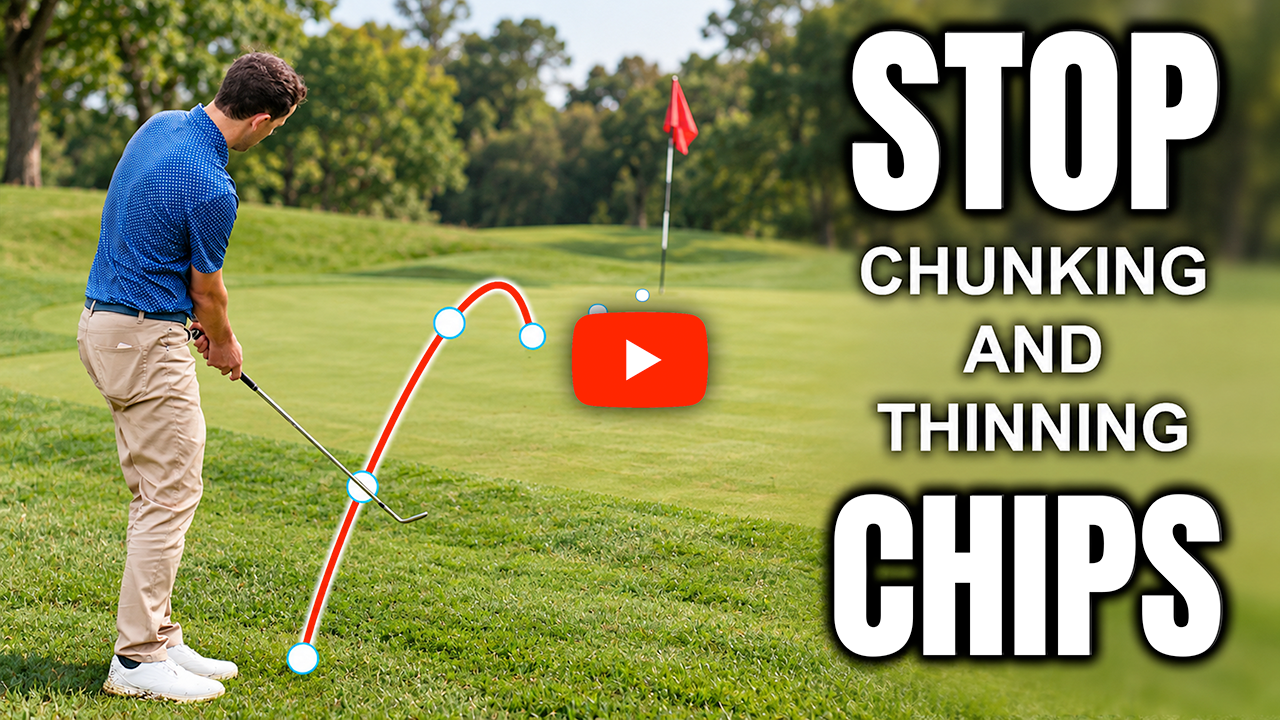
If you Struggle With Chipping, Just Do This Before Every Chip Shot
Oct 06, 2026 Get This Free Practice Plan
Transcript Summary-
Chip shots around the green can be a real source of anxiety, especially when you’re trying to find a technique that gives you consistent contact from different lies. In this video, I share a simple technique inspired by my good friend John Mayall, based around one key difference between good and poor chippers: good players naturally move forward through the shot, while inconsistent chippers tend to move backwards.
The biggest problem for most golfers is hitting the ground too early. When you’re too far behind the ball at impact, you’re much more likely to hit fat or thin shots. Good players tend to get themselves more over the ball and strike the ball before the ground, creating much more consistent contact.
The surprising part is that many of the best chippers use a highly lofted club, such as a 60-degree wedge, with the face opened significantly. This creates a problem that your body naturally wants to solve. As the clubface starts open, your forearms naturally rotate through impact, bringing the face back towards square while allowing your body to move positively towards the target. This helps you strike the ball and then the ground rather than falling backwards.
To practise this, take your most lofted club, move the ball slightly back in your stance and open the clubface significantly. Set your hands slightly higher and imagine the clubface gradually closing back towards square through impact. Rather than focusing on lots of different positions, simply visualise the clubface starting open and then squaring up through the shot. This creates a much more natural and flowing movement.
The same principle can be used when you want to hit a higher chip. Move the ball slightly further forward and allow the club to catch the ground just before the ball. This traps some grass between the ball and the clubface, reducing friction and helping the ball launch higher. The important thing is that you’re still moving positively through the shot rather than leaning backwards and trying to keep the loft on the club.
This technique also works really well from difficult rough lies. Start with the clubface open and allow it to naturally square through impact. You need speed through the shot to get the club moving through the rough, and trying to keep the face open can cause you to slow down and fall backwards. I also like to visualise hitting the ball slightly further than the actual target because the rough can slow the club down.
Ultimately, the goal is to develop a simple pattern that gives you confidence around the greens. By setting up with the face open and allowing it to naturally square through impact, you can encourage a more positive movement towards the target and avoid the backwards motion that often leads to fats, thins and inconsistent contact. The SwingTrainer app can also help identify which movement pattern you’re using and support you in developing a more consistent short-game technique.
Full Transcript- So, I know, look, chip shots around the green can be a real source of anxiety. I've been there, so don't worry, you're not alone with this. And all we really want is a technique that gives us solid contact every time, not just from good lies like this, but from all lies around the green. You want to play a shots out of the rough effectively. Maybe every so often you want to show off to your friends and play that lovely high one. In this video, I want to share with you just a simple, simple technique that I actually got from my good friend John Mayall. He basically, in a sense, said, "Look, good players sit in one category. They have a pattern of movement that ultimately, in a sense, gets them moving forward through the shot. And poor chippers, if you're chipping inconsistently, you're tending to move backwards through the shot." But, in order to have that good pattern, you've got to set up in a certain way, and you've got to do certain things to make it naturally happen. And the great thing is, it's pretty simple to do. Let's have a look. So, it's simply this, right? If you struggle with chipping, it's really simple. You It's only 50/50, right? So, if you struggle with chipping, then you simply hit the ground too soon. Your body, everything here, the club is striking the ground too soon. You are too far this side of the golf ball. Sometimes you'll glide and you'll catch it okay, but most of the time it'll be fat or it'll be thin. Good players and and people who are very, very consis- very consistent will tend to be much more over on this side of the golf ball when they're striking it. That just like in full swing, they strike the ball, then the ground. But, how do good players do this? Well, this is the surprising thing. I don't know about you, but when I was learning to chip, I was taught to use eight irons and seven irons and whatnot. But, the best players are using a 60° wedge. And they're going And people go, "What?" They are, but they don't just do that, look. They use a 60° wedge, they open it up to like 70°. Why do they do that? I don't think they really know. But, what they do do is this. You look at some of the footage I'm going to share with you in a second. That 60° wedge turned to 70. By the time it gets to impact, it has reduced to probably about 55 maybe and is back to square. Why? This is the secret sauce, I think. When that face is open, watch what happens here. If you open up your club face on a 60 and knowing that you can also deal off that 60 through the impact area, look what the arms do. Everything is turning towards where? The target. We can turn towards the target. We can move towards the target. It's a It's a positive movement in this direction to strike the ball then the ground. Very natural and flowing. Now imagine somebody who's not using a 60, but he's maybe using a pitching wedge and they've got this little hump to go over here. Now suddenly look, the club face is is square, not open. There's not enough loft on that. So, what tends to happen? Well, they can't roll through like this because the ball would go left and way too low. So, what do you think they're going to do?
They're going to try to keep it square. Maybe even lean back to try and add loft. Everything is moving their body backwards away on this side of the golf ball where fats, thins and inconsistency lies. So, we need to develop a motion that gets you naturally flowing towards the target. And it's pretty straightforward. So, I've got my 60. Grab your most lofted club and it's a great training tool. Such a great training aid this. Get yourself set up and notice this. I'm standing quite close to this golf ball. I'm going to move the ball back in my stance. I'm going to turn that face out to about as open as you like. Make it a problem, right? A problem that your body has to solve because if I didn't do anything here and just kept it there, like this and lean backwards, that ball would go to the right. My body can feel this. So, what it does is and your body's super smart, it will naturally start to solve that problem. And the way I'm solving it, look, is my forearms are turning down, my thumbs are pointing down to the ground in a natural way, turning this way through to the target. As opposed to, look at this, if I didn't have loft on, I might turn them the other way and now fall backwards here. Can you see that? It's as simple as that, right? So, we get ourselves set up, ball off the back of the foot, hands just a little bit high here, and all I'm going to do, look, is I'm going to swing backwards and imagine that club face just turning down back to square with slightly less loft on it than and it started. And away we go.
Simple as that. And all I'm doing here, as I play this shot here, is I'm visualizing And this is really important to get, you know, rather than focus on all these different positions, visualize what is actually happening here. All I'm doing is the face is there, and I'm imagining that face closing down to back to square and through to impact here. And I'm visualizing, really important as well, a nice low trajectory with a 60°. Low trajectories give you spin. Most of the time people are visualizing much higher trajectories than they really need to hit. Now, I know it sounds There is some good chippers that start with the club face square, but the thing is what I find is when you're square, where do you go? Well, the problem is is you could You could do this, but if you're square, you might then pull it to the left. If you let that club fly through, or worse still, with it being square, you might fall this way and then you're back over here. Starting with it open, it's really only got one way to go, which is to this way, which moves you in this direction. It's a much more positive way of actually setting up. But let's start to test this out now around other shots. And before we do, remember, check out my Swing Coach app. It will identify which pattern you're actually working in and support you with actually developing this technique. But you might be asking, "Well, what happens if when I just want to pop the ball up in the air?" Well, the same principles apply. So, this is the one that really kind of shocked me the most. Like if I want to loft one up in the air, you kind of think, "Well, is it the same?" Yeah, it is. The difference is, look, I'm going to move the ball slightly further forward in my stance. I'm actually going to probably catch the ground a fraction slightly behind the golf ball. The difference is this is that even I'm catching the ground behind the golf ball, I'm not catching it because I'm falling back. I'm still positively moving through the shot. The difference is this is when I catch the ground slightly before the uh before the ball, grass gets trapped between the ball and the face. That reduces friction and gets the ball going a little bit higher. So, let's have a look. So, face open, ball's now further forward in my stance. Um I'm going to play a slightly high shot. So, let's imagine that we didn't have a lot of green to work with. I play this shot here, look. And I'm still look going to imagine this club squaring up through the impact area here. And if anything starting down on the way through at no stage am I trying to keep loft on cuz you can see here that would get me going backwards. So, get myself set, face wide open.
And there you go, look. Pops up much, much higher. Lands and stops much, much shorter. So, but the same principles apply. You can see obviously that's going to be a longer swing. I catch the ground early on that one there and the ball kind of rolls up the face and goes a bit higher. But the same principle, I'm still squaring that blade up through the impact area. So, let's just see how this applies to those horrible maybe rough lies as well. So, as you can see, it's a pretty shocking lie, isn't it? But the same principles, look, apply when you're coming out of the rough. Start with a club face wide open and then allow it to naturally deloft through impact. And even on the way through, look, that club face will actually close through the impact area. At no stage am I trying to keep loft on because watch what that does to my body. Gets me falling backwards, catching the ground early, fats, thins, you name it. Plus, look at this. Where's the speed? There's no speed. We need speed through the rough. So, if we allow that to square up, where's the speed going? Through that shot, and that's what you need to get through the rough. The other thing when I'm in the rough, I always imagine that I've hitting the ball a little bit further needed because the the rough is going to slow my club face down. But, let's have a look at this in action. Just visualize that club face starting open and then gradually squaring through the shot.
Well, I would take that 100 times out of 100. So, same principle. It's just a blessing having this now. It gives me so much more confidence, and I hope it adds some confidence to you, too. Like my SwingTrainer app always shows people with this pattern of motion falling backwards, coming in here as opposed to them naturally staying over the ball, and naturally working up through that shot. If you haven't tried it, go and try it out for 14 days, complete free of charge. Just even just test it for 14 days and then cancel, whatever you need to do to help you with your short game. If you enjoyed this video, give it a thumbs up. Maybe share it with you someone who you know who's struggling with their short game. And if you'd like some help with bunker play, check this video out right here. People are loving it. And also, look, I'll put a QR code somewhere here around my for my SwingTrainer app, or I'll pin access to it to the top comment below this video. But, until next week, have a wonderful golfing week.
