
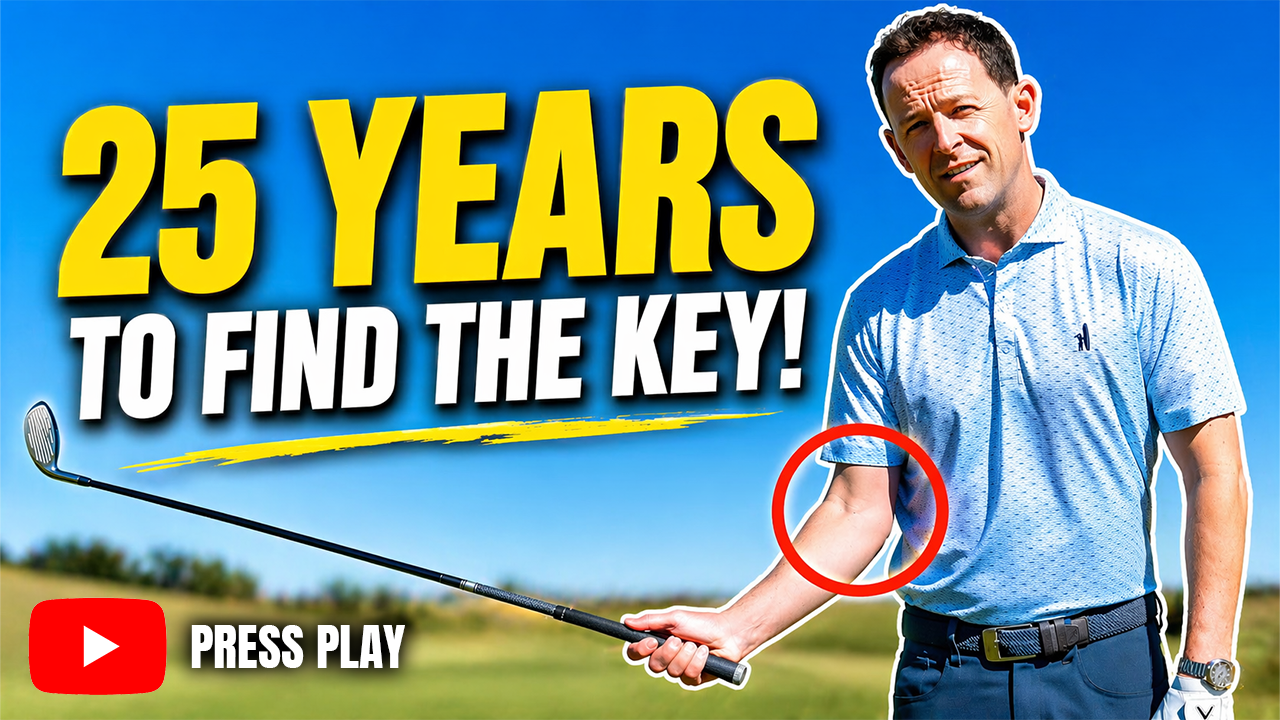
It Took Me 25 Years To Figure This Out---Do This Before Every Shot
May 05, 2026 Get This Free Practice Plan
Transcript Summary-
If you’re struggling with your ball striking—whether it’s irons, hybrids, or fairway woods—you’re not alone. But here’s the thing: most golfers fall into the same trap. They hit a few bad shots, get frustrated, then jump on YouTube searching for the next quick fix. The problem? You’re guessing. You’re trying random tips without actually knowing what’s causing the issue. And that just slows your progress down.
What I want to share with you is something that took me years to truly understand—and it’s something you must do before every single shot if you want to improve. Instead of labelling everything as a “bad shot,” you need to start paying attention to what actually happened. Because every shot gives you feedback, and if you ignore it, you’re missing the fastest route to better golf.
There are three key things you need to become aware of. First, where is your club landing on the ground? Second, how is the club interacting with the ground—are you going too deep or too shallow? And third, where are you striking the ball on the clubface? These three pieces of information tell you exactly what’s going wrong. Without them, you’re just guessing.
I see it all the time with students. They’ll focus on one swing thought—like keeping their hands ahead—but completely ignore the actual strike. The real breakthrough happens when they shift their attention to the feedback. As soon as they notice things like depth of strike or contact point, their body starts to naturally adjust. You don’t always need more swing thoughts—you need better awareness.
It’s the same with strike location on the face. Once you start paying attention to where you’re hitting it—heel, toe, centre—your body instinctively begins to correct it. I’ve seen golfers fix issues like shanks almost instantly just by becoming aware of where the ball is hitting the clubface. That awareness is incredibly powerful.
So next time you practice or play, don’t just hit and react emotionally. Have a clear intention before every shot: observe the strike. Pay attention to those three areas—ground contact, low point, and face strike. Because when you understand your pattern, you can then go and find the right solution for you, instead of guessing.
That’s how you stop tip-hopping and start improving properly.
Full Transcript -
If you happen to be struggling with like your ball strike or consistency of ball striking with your irons, hybrids, or even fairwoods off the ground, you're not alone. But what I want you to do is I want to share with you some with you something that took me almost 25 years to learn. And it's something that you do before every single shot. If you don't do this, you're unlikely to get better at the game, right? I promise you. More likely what you're going to do is you're going to jump onto YouTube. You're going to watch a video like this just in the hope that this is going to sort you out. But you probably find that no matter how hard you try, doesn't really work, does it? So, in this video, I want to basically stop that video hopping, golf tip hopping, random trying random tips in the hope that they're going to work, and instead give you something that I absolutely know works every single time. Now, I want to be honest with you, I didn't get this right as a young player, and it cost me years of of of trial and error. And you know what? I didn't get it right even as a young coach. And if I was again really honest with myself, I probably didn't help as many golfers I could have done in the early years. I don't want you to fall into the same trap that I was doing because it just prolongs the learning program, right? The learning process. So, I'm going to share with you exactly what to do before every single shot in this video. I can't wait to do it. Before I do though, look, if you're new to the channel, it's my first lessons of mine. Please consider subscribing. I release videos just like this one every single week to try and help you improve your game. But you never have to remember a thing. Everything I do here, I'll put into a free download practice guide that I'll pin to the top comment below this video, or you can simply scan through the QR code right there. So, I really think it's probably the most important video on my channel. In fact, I probably should have released this many years ago as video number one. It's that good at improving your golf and particularly with your ball striking. That's what we're going to focus on today. We're going to focus on striking your irons and hybrids and fairwoods much, much better, more consistently off the ground. Now, when you're striking a golf ball, three things you need to be great at. First thing, you need to be great at landing the club in the correct spot every single time. Number one. Number two, you need to be good at controlling the depth that this arc travels on. The club travels on. A lot of times when people are fatting it, they drop the arc, it goes under the ground, and you fat it. Or do you know what? They raise the ark too height and they top it. How do you control that? We're going to explain it in a second. And the third thing, where are you hitting the ball in the face? You got to be good at working out how to hit the center of the face. How do you do that? They're the three things that we need to focus on in this session. Now, to get great at them, you need to do one thing before every single shot. Before I tell you what that is, look at this and tell me, does this sound familiar?
Such a bad shot. Such a bad strike. Okay, go again. Come on. Oh jeez, that's such a bad shot. Now it's gone left as well.
This is what happens, doesn't it? On a golf course, you start hitting some bad strikes, you know, you oh god, you get frustrated. You finish around a golf, you jump onto YouTube and you you maybe click a video of mine or somebody else's and how does to strike your woods, how to strike your irons, and you then go, "Oh, that's it. That's me." And you go and test that tip out. The problem is how do you know that that tip actually is relates to you? Because right now I've just hit three shots, two shots, and all the information I've got from those shots is what? They're good. Not very good. They're bad. Bad strikes. But which one of those three elements am I doing wrong? Because right now, I haven't paid attention. All I've done is hit a shot, got frustrated, ignored the feedback that was there, and lumped it all into one word, bad shot. What I needed to do was this.
Hit the ground slightly behind the baller. Okay, now let me bring you in on a lesson just recently. how this hugely improved this uh Rodney's uh his ball striking. Rodney hit a shot with a wedge and he said, "Danny, I I've been trying to keep my hands ahead of the golf. Watch this." And he hit a shot. He goes, "Oh, that's not it, Danny. Didn't keep my hands ahead on that one." So, he goes again, trying to keep his hands ahead. And next one, he fats it. Okay. No, no, no. That's not quite right. Let me show you again. Now, he's focusing hard on one thing, keeping his hands ahead. But the feedback as to what was going wrong was right there in front of his nose. And all I did was ask a question. I said, "Rodney, how is your club interacting with the ground?" I said, "I don't know." I said, "On this next one, hit another shot." And he goes, "I didn't hit the ground much on that one." Okay, good. Hit another one. I hit the ground a lot on that one, didn't I? Yeah. So what's the fault out of those three things? Depth. So he then went and he didn't even say anything. He goes, "Oh my god." So he made some practice swings and all he did was pay attention to how his club was interacting with the ground. When he went in the practice swing went a bit too deep. He just naturally allowed his body to naturally adjust. And hey, Presto, he got the feeling that he wanted and he just hit it and the strike was amazing. But where did that strike come from? Simple awareness of the depth of the ark. I then had another one of my students, Monty, struggling with his fairywoods, and he's hitting these shots and said, "Oh, Danny, I'm just all over the place. I I just can't hit my fairwoods. I have no idea uh what's going on whatsoever. So, same thing. He hit a shot with a fairywood and he'd just be frustrated. And the frustration and the na, by the way, frust It's really natural for us all to feel frustrated. But I want you to before every shot, have the intention to start to pay attention to those three things. How is your club interacting with the ground? Where is your club interacting with the ground? And where are you contacting on the face? Now, when Monty stood over his fairywood, he was realizing that you know what, he was he was one minute hitting the ground back here, next minute he's hitting the ground over here. He was really, really inconsistent. Once he recognized that, he started to now go, "Right, I need to land the club there." Do you know what his body started to naturally do rather than start to move off all over the place? It naturally it naturally stayed much much stiller because that made more sense to strike the the ground in the same spot every single time. Why did his body respond like that? Well, because he paid attention to where his club was landing on the ground. The other great thing with that is is that if you do have what we call a low point problem, so when we're hitting a fairways here, we want the bottom of the swing to be just pretty much on the ball, maybe even a little bit after the golf ball. Well, now if you know you've got a low point thing, when you go on to YouTube now, you can now start to kind of go for tips that only focus on low point. So what we did with Monty is to kind of really improve it. I gave him the prop drill, right? Which I will link put a link maybe somewhere around here and on that drill that I gave Monty because it actually works every single time to control the bottom of your swing. So we noticed it, we focused on it. We made it better. Then funny enough, I was with my dad. Let me just grab a wedge here. Um, so there we are. So, I'm with my dad and he's shanking the ball and he go and but he didn't talk about that. He said, "Oh god, I'm just I'm so bad at chipping, Danny. I'm just I'm hitting it all over the place." And he's and the frustration you could see every shot. He's almost anxious. I'm hitting it terrible. I said, "Dad, what are you doing?" "Oh, I'm shanking down here." I said, "What does that mean? You're doing one thing wrong. Where are you striking the the the ball? Striking here. That's all you're doing, right?" So, you got to strike it there. Yeah. How do I do that? Well, think of it this way, Dad. How does a tennis player with a ball that's moving at different heights, how do they learn to hit the center of the racket? How do they do that? We hit a stationary ball, but how does a tennis player hit the center of the racket? They do it because they are paying attention to the feedback that they get and their bodies naturally adjust. Yes. So, if they hit the rim of the racket one minute, their bodies are responding. They are become they are aware of where that ball is hitting in the racket. What you want to do now is this. I said to him like all I'm going to do, he's going to hit some shots, Dad. And I want you to now pay attention to where that ball is hitting in the face. And he would call out little names. He go he go and he points to the club and he go, "Oh, that was about there." Like this. He just point to the point to the place of the club it was. So it was still maybe just a little bit in the neck and then a bit a bit uh low down. So off he'd go again. Then he hit another shot and he then immediately point to me here. And do you know what was amazing about this? He never shanked another single shot for the next 25 30 balls in a row. And my dad could shank a ball one after the other after the other. But what had changed? He'd simply paid attention first of all to the fact that he was shanking it. And then what he did is he looked at his golf club. And if this was even fascinating because he was his intention now was to pay attention to where that ball was sitting in the face. He even caught himself to doing one thing just before he went but just before he took the club away. He got a habit of pushing his hands forward towards the neck. I didn't say anything. He spotted it straight away. That one thing was the thing that was causing his shanks. So when you're playing, so that you don't start jumping onto YouTube trying random tips that may or may not work for you, I want you to look next time and and leave a comment below this video. Three things I want you to look for when if you are struggling with your ball striking. One, this is the first thing I would say, the most important one. Depth of arc. How is your club striking the ground? I say depth, that's really important. How is it striking? Then where is that ball uh the club striking relative to the ball? And the third thing is is where are you striking it on the face? You need to learn to feel this. Okay. Now if you find that you are inconsistent with where you're striking the low point, this is the video to start with. If you are struggling with the depth of your arc here, this is the video to start with. And if you if this if you're struggling with contact a center of the face, this is the video to look for. I want to turn you in to a launch monitor just like Trackman. I need you to go have the skill that someone like me as a professional has. Learn to become aware of what's happening in your strike so that when you do jump onto YouTube, you are finding the tips that actually going to work for you. You are bad at eyeplay. You're not bad at driving. You're not bad at fairwood. If you're doing something specifically wrong, we need to discover what that is. And once we do, we can then apply the right fix rather than just try random stuff that have nothing to do or nothing related to what you're doing. All right. Really, really hope this helps. Please, please do share this with as many people as you can because I believe it's probably the first thing they need to do. Hop on to YouTube. Sorry, hop on to the golf course, test yourself out, and let me know down below what specifically are you doing because I promise you there's a pattern there. I hope you enjoyed the video. Give a thumbs up, share it with one of your friends, and of course, look, if you're new to the channel, press that subscribe button somewhere around here.
