
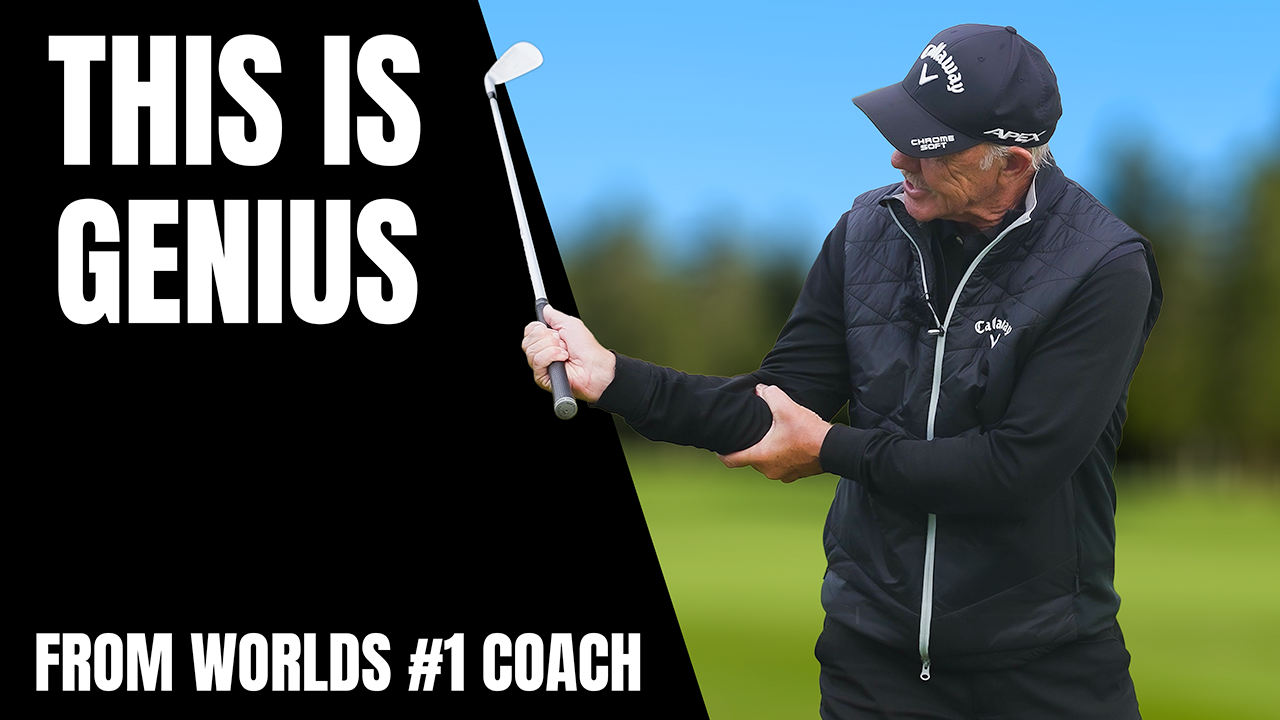
Pete Cowen's Right Arm Secret (It Feels Like Cheating)
Feb 23, 2026 Get This Free Practice Plan
Transcript Summary -
You know, just like many of you, I’ve had to work hard on my own iron play. And a little while ago, I filmed a video with the world’s number one coach, Pete Cowen. It’s been seen by over five million golfers around the world. In that lesson, Pete shared something that I honestly believe could transform the ball striking of every single golfer — but there was one problem. He used this phrase: “spinning the right arm down.” And a lot of people didn’t really understand what that meant.
So, I’ve spent the last few months simplifying it for my students, and the results have been incredible. In this video, I want to show you a really simple move — almost like a little drill you can do before every single shot — to feel exactly what Pete meant by “spinning the right arm down,” so you can start compressing those beautiful shots off the fairway.
Before we dive in, if you’re new to the channel, welcome! I release videos like this every week to help you improve your game, and I always include a free downloadable practice guide — you’ll find that in the top comment below.
Now, to make this all make sense, I want to borrow a great phrase from John Jacobs, one of the old masters of golf coaching. He used to describe the golf swing as “two turns and a swish.” You turn to your right, you turn to your left, and the club just swishes through. Simple, right? The issue is that most golfers don’t really understand what creates that “swish” — and that’s where Pete’s idea of spinning the right arm down comes in.
What most golfers do instead is roll their wrists or flick at the ball. That’s not what we want. The arms in the golf swing are simply working up, down, and up again. If you watch closely, when you hinge the club over your trail shoulder and then add a turn, that’s a proper backswing. From there, all you do is reverse it — spin that trail arm down as you turn through, and the club naturally returns to the ball without any flicking or rolling.
This is what Pete meant. You’re not trying to hold angles; you’re just maintaining them naturally as you rotate. The club stays in front of your body, you get that beautiful compression, and everything feels connected and effortless.
Now, a great way to train this is to have two destinations in mind — one at the top of the swing, and one through the shot. When you finish, instead of having the shaft wrapped around your body, feel like it’s more vertical on the left side of your body, with a little bit of wrist angle still there. That’s your check position.
When you get this right, you’ll notice the club is always in front of your body, both on the way back and on the way through — and the strike just feels pure. My own shots have become so much more consistent with this, and my bad shots are now way more controlled.
Just one thing to bear in mind: this works best when your body’s turning correctly. If your body movement isn’t great, your arms will try to compensate, and that’s when problems creep in. So, if you want to get that part sorted, I’ve got another video linked right here that’ll help you move your body more efficiently through the swing.
Remember — the golf swing is just two turns and a swish. Now that you understand how the “swish” really happens, go try it out, and I promise — you’ll start feeling that crisp, effortless compression you’ve been chasing.
Full Transcript- So, just like you, I need to work on my young game. And a while ago, I filmed a video with the world's number one coach, Pete Cowan, and it's been viewed by over five million golfers around the world. In that video, he shared something that I believe could transform the ball striking of every single golfer on the planet. The problem is he used a phrase called spinning the right arm down, and a lot of people didn't really understand what it meant. So, I spent the last few months trying to really simplify it for my students and the results have been incredible. In this video, I want to share with you the simple thing that you can do almost like a simple drill you can do before every single shot to give you the sensation of actually what he meant spinning the right arm down so you can start to compress all of those beautiful shots off the fairway. Can't wait to can't wait can't wait to share it with you. Before I do though, look, if you're new to the channel, it's one of your first lessons of mine. Please consider subscribing. I release videos just like this one every single week to try and help you improve your game. Plus, you never have to remember a thing. Everything I do here, I'll put into a free download practice guide in the top comment below this video. So, by the end of this lesson, I don't want you just to be striking the ball beautifully well and gaining more distance. I want you to feel like the golf swing makes sense and you feel it's repeatable and easy and therefore so you can just naturally walk onto the golf course and feel confident. All right. Now, to do that, I want to um coin a phrase from a very, very old coach called John Jacobs who described the golf swing as two turns and a swish. So, you turn to your right, you turn to your left, and you let the club look just swish along. And I love that in its simplicity. The problem is the swish bit is in a sense what a lot of people don't really get. And this is what Pete was talking about in terms of like spinning the right arm down. You see, a lot of times what's happening is this. golfers are rolling their wrists and they're releasing the club like this. Some release it like this. They don't really understand how to use their arms and create that swish. Now, ultimately, this is all the arms do in the golf swing. So, look at this here. Look really carefully now as I set up. And you could do this before the each shot. You get yourself set up like this. And all I'm going to do, look, is I'm going to hinge that club over my trail shoulder like this. Yes. So, it's almost going towards my my trail ear here. Now, if I added a turn into this, you can see now look at this. That's a proper golf swing. Okay. Now, let's do the other thing. If I was to take the club now and move it straight over my leader like this. Okay. there and I turn now. Look at this. We're into almost a full swing position. Does that make sense? Yeah. So, notice this. At no stage am I rolling or flicking or doing anything. The golf swing is working up. It's working down and then it's working up again. This is ultimately all that the arms are doing. So, if we start to look at this as I turn now, if I make a turn, nothing's happening. All I'm doing is simply tilting towards the ground here, making a turn. At this stage, I'm now going to do this. As I continue my turn, if I turn back, there I am. Makes sense, right? So, that's all the arms are doing. On the way through, they are working back down. And this is what Pete was talking about with spinning the arm down. From here, look as they work down this right arm, this trail arm here is simply doing this. That is it. This right now, what was I doing? I would do this. Then the problem is I would flick. What do a lot of players do? As opposed to turn the arm down, they would try to square the face with a roll or a flick of the wrists. No, it's this. If you spin the arm down, all I'm doing is this. I've kept the wrist angle naturally intact. I aren't, by the way, holding that in any shape or form. It's just working down. Yeah. And I've still got my wrist angle as I come through here. And I know where I'm going now, which is this way. And I'm here. Notice the club now feels quite vertical. I've still got my wrist angle in here. I haven't held that wrist angle. It's just there. Right? Most people would be here, here, chicken wing, all over the place. Right? So, let's simplify that now to something that you can actually transfer to a shot on a golf course. So, you get yourself set up here and we need to know that ultimately the golf swing now is simply this. that all the club is doing. You're going to move it over your trail here. And we could start just for now just on a back swing. The only thing we add into this now look here is a pivot. And hey, presto, we've got a back swing. The club look is beautifully in front of the body. We haven't done this. Taken it back with our arms, pulled it inside. Yeah. The body moves the club away. Yeah. And then we naturally just hinge those wrists as we've just done and it works it up. But the body continues to turn, right? That's what brings the club around. As we're coming back down to impact, we turn back. And then from here, look, as we continue turning through that club, now look, he's going to rehinge up here. And that's kind of what we're going for, right? This is me. Look, turning or we call it spinning the arm. Spinning the arm. Down. Up. Down. Up. No. No, no, look. Spin. Now look. One. Now I blend this all into one. Look at this here. I am now going to turn it down. And now move down. And then look, I keep turning it down. And now it's working up. Make sense? Into this place. What I am doing here, look, is here driving it, trying to hold the angle. I'm neither trying to flick it because if I continue that motion, I'm around here. I'm not trying to flick this way because then I'm like here. What I'm doing, look, is spinning the arm down here. I'm continuing to work it up into that place right there. Okay. So, you now have in theory two destinations and you could work on one or the other. Does that make sense? So, let's turn the track mind back on and let's show this in action. I'll show you when you're working on this. I I I hate focusing on positions. So, I think understanding what things do and then try and allow your body to n your body's pretty smart. Allow uh your body to figure this out. So, what I do initially is this. You won't be perfect. It's about timing this. So, you know, as you turn to your right and you turn to your left, the idea is that you're in a sense timing this arm motion up, right? So, let's imagine here what I'm going to do here is this. One of my problems would be when I'm coming through, I'd slide too much here. I drag the handle and then all I've got left now is look, as opposed to just doing this, I've gone too much like this. I've got a flip. And I still do this now and then, right? It's not perfect. But what I do now is I'm going to b I'm going to turn the that forearm down. Not by getting the club like this. I'm turning my forearm down. That's what squares the club. I keep turning through the shot there. And as I'm coming up now, I've still got that beautiful kind of control of that golf club versus just a flick of those wrists. Okay? And then what we get is this beautiful, lovely, really lovely compression.
Look at this. That's an eight iron there. And it's absolutely just And I can do this time and time again. And so can my students once they really get this, they're not holding on to angles because look, we are releasing those angles down and through. Right? But now look, we know where we are heading towards. This way, this way. Not here. Not here. Look, I'm turning it down. And I keep turning it down here. I've still got, look at that angle there. I've still got the angle in my wrist here. Not because I've held it. I'm rotating it down onto that golf ball here. All right. So, look at this here. Back swing. There's your finish. The body's kind of matching there. The club's in front of my body. It's coming back down here. Look at this. And now, where's the club again? In front of my body. No. No. And that's what we're going for.
There we go. look nice and straight. So when you're doing this, you know, one thing to kind of kind of take it keep it really simple for the golf course would be kind of have a destination to go to. So you could focus on back swing or you could just make sure look I'm making a nice leisurely turn, right? And then what I'm going to do is is I'm just going to imagine finishing with rather than the shaft over here, I'm going to imagine it's just on that left side of my body here, I'm going to finish with it feeling like quite vertical here. And you'll notice I've still got a little kink in that hand here. It's not here. Those arms out apart here. They're not crumpled in. They're just sitting really relaxed. And the idea is is that you've now got, look, a destination to go to. So, it's just if you reverse engineer the swing, you can get the spinning of the right arm for free because if it throws, that's going to give you that destination. If you flick, that's going to give you that destination. But if you spin the arm down here, rotate through, you'll still see, look, that club nice and vertical here. The left elbow's going to be pointing fairly downwards. I'm still going to have a nice kink in my in my trail hand. This gives me the the basically what's happening here is the club is working out to the golf ball, not because I'm throwing it and losing that wrist angle, but because I'm spinning the right arm down and I'm turning onto the shot here and then through. Right. So knowing that destination can be a really a really important factor
and you see that it's just really really consistent. And look I'm not perfect but what's I'm personally finding so as well as my students from this lesson my bad shots are much more under control with every I mean every shot on the fair being absolutely incredible. So with that in mind, just one thing to bear in mind when you're doing this, my body works reasonably well, right? So watch out for this. Most times when people are getting into kind of problems with these arms, it's often because their bodies aren't working as efficiently as they should do, right? If that's the case, just watch out for that. And if you do need some help moving your body correctly, do check this video out right here. Because look, the golf swing is a a turn, two turns and a swish. We've talked about how this the swishes happen and how you work those arms. It really helps to get the body working efficiently. If the body's working all over the place, that can make things quite difficult and you're going to have to use your arms often to kind of compensate and correct. So, do check it out. Look, if you're new to the channel, press that subscribe button somewhere down here. If you want more personalized help from me, head on over to dannymore.com. I'll leave a link in the top comment below with the practice plan.
