
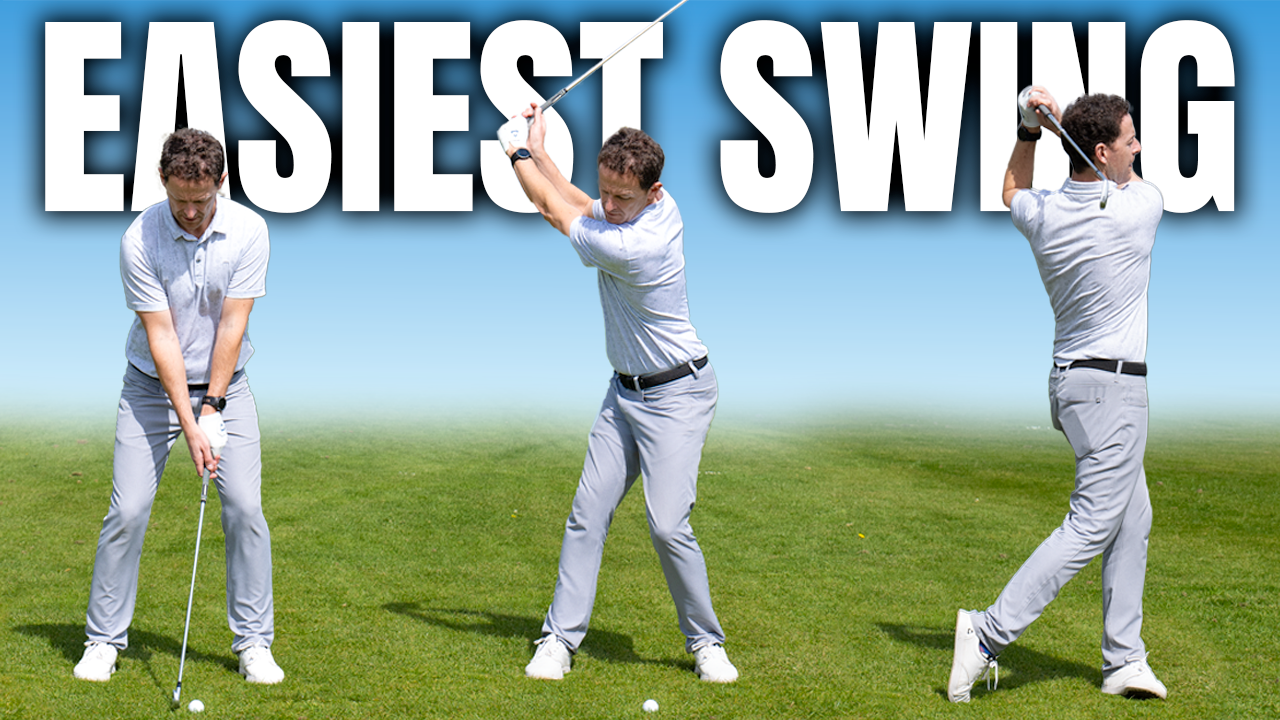
This One Move Can Make Your Golf Swing Feel So Effortless
Sep 14, 2026 Get This Free Practice Plan
Transcript Summary- When you start struggling with your ball striking on the golf course, it’s very easy to start trying lots of different things to fix it. The problem is that most golfers end up overthinking and making things even worse. In this video, I want to share one simple concept that I’ve found works really well for my students, particularly when they’re out on the golf course. I even shared it with my wife, Laura, who is a beginner golfer returning to the game after a long layoff, and she found it incredibly simple and effective.
A common problem I see with amateur golfers is too much movement from side to side during the swing. This often happens because the shoulders and eyes stay too level, even though we’re playing golf with an angled golf club. Because the club is angled, we need to understand that the golf swing naturally works on an angle too. If you can maintain that angle with your shoulders, eyes and ears, you give yourself a much better chance of staying over the golf ball and striking it consistently.
The simple visual I gave Laura was to focus on the finish position first. I want you to imagine that your trail shoulder is lower than your lead shoulder, your trail eye is lower than your lead eye and your trail ear is lower than your lead ear. Then, rather than worrying about everything else in the swing, simply make a swing and collect the golf ball on the way to that finish position. I call this my reverse-engineer method because if you start with the end in mind, your body can naturally organise the movements needed to get there.
This is particularly useful because it can help prevent you from moving off the golf ball or coming over the top. If you start levelling your shoulders on the way through, you’ll often see the body lunge forward, the head move and the trail shoulder stay too high. That can lead to a slice, a loss of speed and inconsistent contact. Instead, we want the head to act almost like a brake while the club catapults through on an angle.
When you’re practising this, start with small, controlled swings. Set yourself up, make a rehearsal swing and check your finish position. Ask yourself: is my trail shoulder lower, is my eye line angled and is my trail ear lower? Then simply make the swing and collect the ball into that position. As you become more comfortable, you can gradually make the swing bigger and start generating more speed.
The beauty of this drill is that you don’t have to think about lots of different swing mechanics. Start with the destination in mind and allow your body to organise itself around that movement. If you notice your head moving forward or your shoulders becoming level, you’ve got something very simple to work on.
Give it a try the next time you’re struggling with your ball striking on the course. It’s a simple visual that can be used with every club in the bag, and it could be exactly what you need to get your swing feeling effortless and consistent again.
Full Transcript- Do you know when you're on the golf course and you start to struggle with your ball striking? Maybe off the fairway or even off the tee it starts to go all over the place. It's not always easy to know what to do, is it, at that point? You you try a lot of bunch of things. Some may work, but often they don't. What I want to do is in this video is share with you one thing that seems to work more often than not. It often helps my students, uh particularly on the golf course. And I shared this, funnily enough, with my wife just yesterday. Now, she's a beginner golfer. She's returning to golf after years lay off, really. She She injured injured herself. And she doesn't like a lot to think about. And her swing was all over the place. Her ball striking, naturally, was all over the place. And I gave her this one simple visual, one simple drill, that I often share with many of my students. And it kind of worked instantly. More importantly for her, she said it was very, very simple to kind of do. And it felt really relaxing and gave her this effortless motion. I'd love to share it with you, because, like I said, it could be something that you can take straight to the golf course to help you with every single club in the bag. Before I do that, look, if you're new to the channel, this is your first lesson of mine, please consider subscribing. I release videos just like this one every single week to try and help you improve your game. Plus, you never have to remember a thing. Everything I do here, I'll put into a free download practice guide that I'll pin to the top comment below this video. Or you can simply scan a QR code right there. So, I know how frustrating it can be on a golf course. You're trying a lot of things that are not really working. But I think this, just this concept alone, could really, really help. So, we're going to start with the irons and then we're going to move potentially to the driver if we've got enough time. So, ultimately, Laura was a saying my wife, but I see this a lot. You know, a lot of golfers are moving excessively side to side off the golf ball. And it's going to hamper your ability to strike the golf ball. The other thing I'm finding is is when they're getting to through impact here, I'm seeing a breaking down of the arms, a flicking style of motion here. This is pretty common, and it's one of the biggest reasons why people are struggling with ball striking. But how do you fix it in a very effortless and easy way? Well, what worked incredibly well for Laura and works uh for many of my students is just understanding that the concept of a golf swing is that we play golf with angled golf clubs. And because we play with angled golf clubs, we swing on an angle. Now, this is important cuz if you have a look at some of the footage of Laura swinging, and this is an exaggerated version cuz she's a beginner, but I see this a lot with many amateurs, is is there's a lot of movement side to side often because their shoulders are staying very, very level. Does that make sense? Now, all I said to Laura, I said, "Look, your shoulders and your eye line can stay very level if you if you played golf up here, right? But because we play golf with angled golf clubs, what I want you to notice here is this. Look at my swing. What do you notice about my right shoulder? I mean, my left shoulder, my right shoulder is lower than my left halfway through. What do you notice about my eye line? My right eye is lower than my left eye. And my ear, right ear, is lower than my left. When I'm finishing through here, I'm finishing and I'm swinging on an angle. Now, the reverse is true on the backswing. You see the difference? Like there's always an angle, and this is really important because when you start to swing on an angle, can you see how suddenly I stay more over the golf ball, not only on the way back, but look at this now. As I swing on an angle on the way through, can you see how I'm much more over the golf ball? It gives me a better chance to be more consistent. Watch what happens, however, if on the way through now I start to level them off. Can you see how everything starts to lunge forward? Same on the way back. If I don't do this, but actually move this way and level them off, can you see how I'm moving off the golf ball? So, just a simple visual to start with, swinging the club on an angle. Now, how I got Laura to work on it, and again, many of my students do the same, is I love to get you to visualize the finish position. So, all I said to Laura was really simple. I said, "Look, Laura, what we're going to do is I want you to start from here. I want you to swing through and all I want you to do really simply here is swing the uh through here and notice your trail shoulder here, right shoulder, stays where it is relative to your left. It should be lower. Where's your eye should be lower. Where's your ear should be lower than your left ear. Right? That's all you need to do. Picture that arc going through. That's all I care for. Now, I call this my reverse-engineer method because if you start with the end in mind, imagine if you know your destination, your body naturally starts to work on the way back on an arc. On the way down, like you're less likely to swing over the top if you're a slicer cuz look where that would lead, level shoulders. Notice this, I'm more likely look to swing on the arc on the way down because of that's where I'm planning to finish. So, this was stage number one. I said, "Get yourself set here. Get yourself set up." And I said, "Look, make a few swings." And I said to her, "Don't worry too much about the strike for now. I want you to collect the golf ball on the way to this finish position." So, it looked something like this. Get yourself set. Do a rehearsal. Is ask yourself, "Is my right shoulder lower than my left? Is my eye line angled?" If it is, great. Then just make a swing and just collect the golf ball into that finish.
So, we hit the shot. Look at the finish position. Notice where the shoulders are relative to each other. That this should be lower. My ear should be lower. My eye line should be angled. Now, when she did this, she did it first time, couple of times, but then as she kept going with it, she started to miss the practice swing and the rehearsal, which is a very, very common. And then what happened, which is again really normal, so watch out for this when you do this, okay? Cuz this is a real speed loss. If you want to If you find yourself losing power, this can be a real big problem. What she then started to do without realizing is that she was trying to kind of visualize this motion, but her head started to move forward. As your head moves forward, what happens to the shoulder? It stays high. This is your slices. This is your coming over the top. This is your loss of speed. We want the club look to catapult. When the head stays as a break stays back and allows this to come through on an arc like this, can you see now how not only are we able to keep the angle, we're able to catapult that club through. It makes sense. Very different look if the head moves, the uh shoulder stays high and you finish level. This is why I think this drill is so so good. So, imagine now you're out on the golf course. You stand behind the golf ball. You get yourself set. And all you do is you make a simple rehearsal back. And you're visualizing each time, look, ask yourself where uh my eye line, where's my shoulder line, where are my ear Where's my ear line? Now, when Laura did this, we kept with very controlled, fairly short swings to start with, actually, cuz this is all she needed. But you have after a while, you can just keep extending further and further back, cuz now, look, you can power through to your destination, okay? But to start with, this is just a brilliant brilliant visual. So, basically, simple as that. Get myself set. I've got my feeling. I've got my visual. And again, all I'm doing is I'm going to collect the golf ball on the way.
And I'm absolutely rip that one straight down the middle of the fairway, okay? So, start with the end in mind. The end in mind can inform your body. It means that you don't have to think about many things. If you know your destination, your body will kind of organize itself around that destination then try to achieve that. When you do it, and it maybe is slightly off like it was with Laura, great. You can recognize that. Then you can go, "Oh, head's moved." There we go. Now we can practice catapult. We can start to even extend it. We didn't get to extending with Laura cuz I only had 5 minutes with her anyway. It was just a fun thing. We were in the studio. So, give it a go. Let me know in the comments how you get on. And I said I'd I'd like to apply this to driver. I will do that. I'll probably look at doing that maybe next week. But if you'd like like almost like a personalized lesson from myself, consider downloading my new Swing Coach app for a 14-day trial. It will literally analyze your entire golf. It'll tell you what you're doing wrong, but more importantly, it will give you drills just like this one and show you how to fix it. I'll put a a link to in the top comment below this video, or you can simply scan the QR code right there. Now, as well as the full swing, I've got many short game videos. If you're looking at improving your short game, check this video out right here. But until next week, have a wonderful golfing week.
Full Transcript- Do you know when you're on the golf course and you start to struggle with your ball striking? Maybe off the fairway or even off the tee it starts to go all over the place. It's not always easy to know what to do, is it, at that point? You you try a lot of bunch of things. Some may work, but often they don't. What I want to do is in this video is share with you one thing that seems to work more often than not. It often helps my students, uh particularly on the golf course. And I shared this, funnily enough, with my wife just yesterday. Now, she's a beginner golfer. She's returning to golf after years lay off, really. She She injured injured herself. And she doesn't like a lot to think about. And her swing was all over the place. Her ball striking, naturally, was all over the place. And I gave her this one simple visual, one simple drill, that I often share with many of my students. And it kind of worked instantly. More importantly for her, she said it was very, very simple to kind of do. And it felt really relaxing and gave her this effortless motion. I'd love to share it with you, because, like I said, it could be something that you can take straight to the golf course to help you with every single club in the bag. Before I do that, look, if you're new to the channel, this is your first lesson of mine, please consider subscribing. I release videos just like this one every single week to try and help you improve your game. Plus, you never have to remember a thing. Everything I do here, I'll put into a free download practice guide that I'll pin to the top comment below this video. Or you can simply scan a QR code right there. So, I know how frustrating it can be on a golf course. You're trying a lot of things that are not really working. But I think this, just this concept alone, could really, really help. So, we're going to start with the irons and then we're going to move potentially to the driver if we've got enough time. So, ultimately, Laura was a saying my wife, but I see this a lot. You know, a lot of golfers are moving excessively side to side off the golf ball. And it's going to hamper your ability to strike the golf ball. The other thing I'm finding is is when they're getting to through impact here, I'm seeing a breaking down of the arms, a flicking style of motion here. This is pretty common, and it's one of the biggest reasons why people are struggling with ball striking. But how do you fix it in a very effortless and easy way? Well, what worked incredibly well for Laura and works uh for many of my students is just understanding that the concept of a golf swing is that we play golf with angled golf clubs. And because we play with angled golf clubs, we swing on an angle. Now, this is important cuz if you have a look at some of the footage of Laura swinging, and this is an exaggerated version cuz she's a beginner, but I see this a lot with many amateurs, is is there's a lot of movement side to side often because their shoulders are staying very, very level. Does that make sense? Now, all I said to Laura, I said, "Look, your shoulders and your eye line can stay very level if you if you played golf up here, right? But because we play golf with angled golf clubs, what I want you to notice here is this. Look at my swing. What do you notice about my right shoulder? I mean, my left shoulder, my right shoulder is lower than my left halfway through. What do you notice about my eye line? My right eye is lower than my left eye. And my ear, right ear, is lower than my left. When I'm finishing through here, I'm finishing and I'm swinging on an angle. Now, the reverse is true on the backswing. You see the difference? Like there's always an angle, and this is really important because when you start to swing on an angle, can you see how suddenly I stay more over the golf ball, not only on the way back, but look at this now. As I swing on an angle on the way through, can you see how I'm much more over the golf ball? It gives me a better chance to be more consistent. Watch what happens, however, if on the way through now I start to level them off. Can you see how everything starts to lunge forward? Same on the way back. If I don't do this, but actually move this way and level them off, can you see how I'm moving off the golf ball? So, just a simple visual to start with, swinging the club on an angle. Now, how I got Laura to work on it, and again, many of my students do the same, is I love to get you to visualize the finish position. So, all I said to Laura was really simple. I said, "Look, Laura, what we're going to do is I want you to start from here. I want you to swing through and all I want you to do really simply here is swing the uh through here and notice your trail shoulder here, right shoulder, stays where it is relative to your left. It should be lower. Where's your eye should be lower. Where's your ear should be lower than your left ear. Right? That's all you need to do. Picture that arc going through. That's all I care for. Now, I call this my reverse-engineer method because if you start with the end in mind, imagine if you know your destination, your body naturally starts to work on the way back on an arc. On the way down, like you're less likely to swing over the top if you're a slicer cuz look where that would lead, level shoulders. Notice this, I'm more likely look to swing on the arc on the way down because of that's where I'm planning to finish. So, this was stage number one. I said, "Get yourself set here. Get yourself set up." And I said, "Look, make a few swings." And I said to her, "Don't worry too much about the strike for now. I want you to collect the golf ball on the way to this finish position." So, it looked something like this. Get yourself set. Do a rehearsal. Is ask yourself, "Is my right shoulder lower than my left? Is my eye line angled?" If it is, great. Then just make a swing and just collect the golf ball into that finish.
So, we hit the shot. Look at the finish position. Notice where the shoulders are relative to each other. That this should be lower. My ear should be lower. My eye line should be angled. Now, when she did this, she did it first time, couple of times, but then as she kept going with it, she started to miss the practice swing and the rehearsal, which is a very, very common. And then what happened, which is again really normal, so watch out for this when you do this, okay? Cuz this is a real speed loss. If you want to If you find yourself losing power, this can be a real big problem. What she then started to do without realizing is that she was trying to kind of visualize this motion, but her head started to move forward. As your head moves forward, what happens to the shoulder? It stays high. This is your slices. This is your coming over the top. This is your loss of speed. We want the club look to catapult. When the head stays as a break stays back and allows this to come through on an arc like this, can you see now how not only are we able to keep the angle, we're able to catapult that club through. It makes sense. Very different look if the head moves, the uh shoulder stays high and you finish level. This is why I think this drill is so so good. So, imagine now you're out on the golf course. You stand behind the golf ball. You get yourself set. And all you do is you make a simple rehearsal back. And you're visualizing each time, look, ask yourself where uh my eye line, where's my shoulder line, where are my ear Where's my ear line? Now, when Laura did this, we kept with very controlled, fairly short swings to start with, actually, cuz this is all she needed. But you have after a while, you can just keep extending further and further back, cuz now, look, you can power through to your destination, okay? But to start with, this is just a brilliant brilliant visual. So, basically, simple as that. Get myself set. I've got my feeling. I've got my visual. And again, all I'm doing is I'm going to collect the golf ball on the way.
And I'm absolutely rip that one straight down the middle of the fairway, okay? So, start with the end in mind. The end in mind can inform your body. It means that you don't have to think about many things. If you know your destination, your body will kind of organize itself around that destination then try to achieve that. When you do it, and it maybe is slightly off like it was with Laura, great. You can recognize that. Then you can go, "Oh, head's moved." There we go. Now we can practice catapult. We can start to even extend it. We didn't get to extending with Laura cuz I only had 5 minutes with her anyway. It was just a fun thing. We were in the studio. So, give it a go. Let me know in the comments how you get on. And I said I'd I'd like to apply this to driver. I will do that. I'll probably look at doing that maybe next week. But if you'd like like almost like a personalized lesson from myself, consider downloading my new Swing Coach app for a 14-day trial. It will literally analyze your entire golf. It'll tell you what you're doing wrong, but more importantly, it will give you drills just like this one and show you how to fix it. I'll put a a link to in the top comment below this video, or you can simply scan the QR code right there. Now, as well as the full swing, I've got many short game videos. If you're looking at improving your short game, check this video out right here. But until next week, have a wonderful golfing week.
