
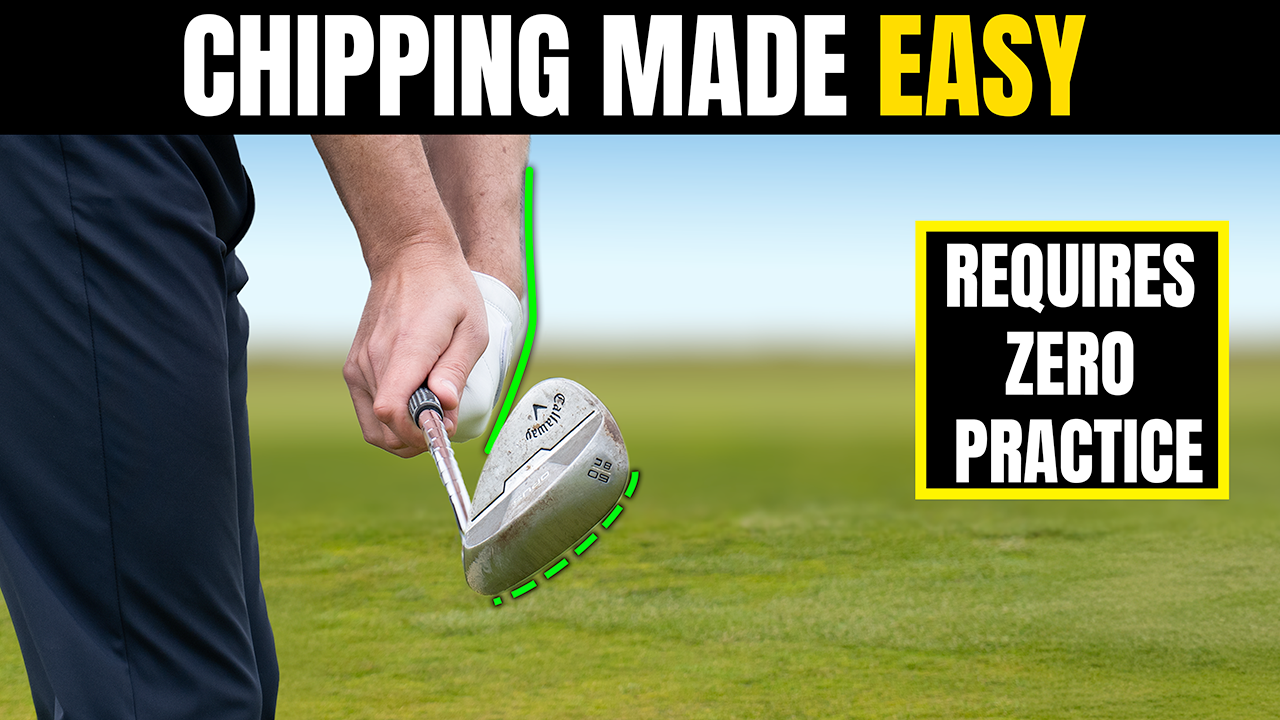
This Ridiculously Easy Chipping Technique Requires Almost No Practice
Mar 09, 2026 Get This Free Practice Plan
Transcript Summary-
How often do you play with someone who seems to make chipping look unbelievably easy? They walk up to the ball relaxed, confident, barely look like they’re trying… and the ball finishes right next to the hole. Meanwhile, you’re standing over the same shot feeling tense, worried about thinning it or fatting it, and hoping the next YouTube tip will finally fix your chipping. The truth is, the problem usually isn’t that you don’t know enough tips — it’s that your movement pattern isn’t working for you. In this lesson, I want to show you how changing a few simple movement patterns can help you strike chip shots more consistently and build real confidence around the greens.
First, we need to bring flow and rhythm into the motion. When golfers struggle with chipping, they often become very focused on hitting the ball correctly, which makes the movement jerky and tense. Instead, imagine the club simply swinging back and through with a natural flow, almost like you’re throwing a ball. The ball should feel as though it just gets in the way of that motion. By making a few relaxed swings and letting the club move freely, you start to remove the tension and allow a smoother, more natural rhythm to develop.
Once you have that flow, the next step is improving your body motion. Many golfers rotate too much on the backswing, which causes the club to move inside and makes solid contact difficult. A much simpler and more reliable pattern is a gentle rocking motion of the shoulders. Think of rocking your shoulders back and through rather than twisting your body. This keeps the hands more stable, the club moving up and down naturally, and it helps create the kind of simple, repeatable motion you see in great short-game players.
Finally, we need to control the depth of the swing arc so you strike the ground and ball consistently. A common mistake is golfers driving their body downward toward the ground during the downswing, which often leads to fat shots. Instead, great chippers tend to do the opposite — as the club swings down, their body gently rises or straightens slightly. This subtle upward movement helps control the bottom of the arc so the club brushes the ground cleanly rather than digging into it.
When you combine these three patterns — a flowing rhythm with the club, a rocking shoulder motion, and a gentle rise through the strike — you create a simple, repeatable chipping action. From there, you can start to develop more skills like controlling trajectory and distance. But the most important step is building these patterns first, because once they’re in place, solid contact becomes far more natural and your confidence around the greens starts to grow.
Full Transcript - How often do you play with a friend who's brilliant at chip shots around the green and they have this way of they walk to a chip shot unbelievably relaxed, confident, and it's like they're not even trying and they get up there and just casually just hold the chip shot just like that. Yet, you stand over a short game shot like this and don't have that at all. You're really tense. you kind of you've got a lot of anxiety going on and you're so nervous of whether you're going to fat it or thin it and then then what you do is you jump on a video like this and you in the hope that this is the video that's going to fix your chipping. Now the problem is what I'm going to do in this video is that shot there that I hit into the hole. What makes it relaxed and consistent and gives me confidence is I have a pattern of movement that leads to great chipping. What I'm seeing with a lot of golfers, and you might be the same, is if you're struggling with chipping, it's not a magic golf tip that's going to solve this thing that just fills your head with more golf instructions. What we need to do is just simply change your pattern of movement. When you change your pattern of movement, you too can start to effortlessly start striking those chip shots consistently, and then you can expand that and build the skill for many chip shots around the green. That is what I'm going to cover in this week's video. Before I do though, look, if you're new to the channel, it's one of your first lessons of mine. Please consider subscribing. I release videos just like this one every single week to try and help you improve your game. Plus, you never have to remember a thing. Everything I do here, I'll put into a free download practice guide that I'll pin to the top comment below this video. So, by the end of this video, I want you to start to have some real confidence over these short shots around the green. Confidence that you know you're actually going to strike it. Cuz I think for me, that is the number one anxiety, isn't it? Certainly was for a recent student of mine, Danny, this week. He would approach shots. He really didn't know whether he was going to fat it or thin it. And he'd been jumping onto YouTube trying to find lots of different, in fact, tried lots of different tips. The problem was is none of those tips fixed it because he didn't fix his overall pattern. He had a poor pattern and then we're starting to put all these different band-aids in. That just doesn't work. What we did was simply fix his overall pattern to provide a more rhythmical motion. and all of these complicated things, they just naturally kind of they just happened, right? And that's what I want for you, too. And here's the bonus with this. Look, data from my shot scope what tells me, look, you can practice like hell on your driver, but if you improve that by 10%, you're only going to drop 0.02 shots. If we can improve your shot game, on average, the average player could save 4.9 shots around. This is how important this is. So, take a look at this and tell me what you see. These are different patterns. This is the first pattern.
This is a different pattern.
What do you see? You see one's rhythmical, C and one's a little bit jerky. So the very first thing and and fundamentally this has to exist in short game. The ball gets in the way of the swing. The ground gets in the way of the swing. most of the time and it's completely understandable. This was a certainly a situation for Danny. When you struggle with strike, what do you want to do? You want to improve your strike, but you make striking the ball very, very important. Instead, what we want to do before we move on to the body, I want you to start to make some motions where the club is swinging and it doesn't re we don't really know where the target is almost. Yeah. The ball would just get in the way of that motion. very much like if I was throwing a ball to you. Yeah. No, there's a movement, right? This is incredibly important. So, the very first thing I did with Danny is this. He didn't have correct body motion. I'm going to show you what we did in a second, but without a flowing motion, there's no chance. So, you could have poor body mechanics and have some flow and you could get away with some pretty average movement, right? So, let's get ourselves set. All I'm going to do now is this. I want you to do this the same. Maybe even grab a club and just swing the club backwards and forwards and see if you can feel the momentum of this golf club swinging backwards and forwards in a flowing manner as if the ball would simply get in the way of that club. Right, we start with that motion initially. Now remember Danny had and maybe you're the same had a bit of anxiety with a lot of these things. So initially he could feel the jerkiness but that's great. I said, "That's fine, Danny. Just keep swinging. This is your practice swings. Allow the club just to flow throw through flow through. If I was throwing a ball to you, look, there's a little bit of an impulse. I'm not just going like this. There's a impulse to this. There's a throw to this. So, I got him to keep swinging backwards and forwards and allowing I imagine the ball would get in the way of this. He would hit the ground a little bit behind the golf ball. We would hit the ball first sometimes, but suddenly the jerkiness started to stop. And that's really, really important because once the jerkiness stops, it allows us then to work on the correct body motion. So, one more like that. Get ourselves set. Couple of practice swings. Just feel as if the ball doesn't really exist. And ultimately, the club's swinging backwards and forwards and just gets in the way of that ball. So, I know that I didn't per I purposely didn't put great mechanics on that, but it doesn't matter. The club is swinging. That's f the first pattern. Now, let's start to work on the body pattern to create great contact every time. Take a look at this and tell me what you see.
This is one pattern. This is another pattern.
See the difference? Too many players, and Danny was the same, too many players have excessive rotation on the way back. The hands roll inside and when you rotate, your body starts to move up to the right. That can cause you to fat it. Now, the problem is the path's coming way too far to the right. Then we suddenly start to flick our wrists. Lots of things are happening. Now, what Danny did is he gone to YouTube and he said, "Look, yeah, I'm coming inside." And he'd try and get the club outside. The problem is is he had a pattern of movement that naturally led to this. All I needed him to do was simply said, "Danny, look, we can get all of this club working beautifully up and down. If you just change your pattern to, as opposed to a twisting motion, just create a rocking motion." So I said to him, look, imagine this here. All we're going to do is going to rock the shoulders back down. And look at this through. There's a little rotation as we come through, but ultimately, look, it's more of a rock. And if we rock, look, can you see how the hand stays on top? The club just stays where it is. No rotation whatsoever. I'm coming back down and rocking back down and now look through the shot. So you get a lot of the beautiful mechanics what you see with the top players simply by having the pattern of movement that is more of a rock versus look a rotation around. So that for him was a bit of a game changer. So we get ourselves set here. He's like my god that feels so simple. So we get ourselves set so that imagine now all you're going to do look for now you've got the flowing club right we've learned that. Now, what you're going to do is you're going to give that flowing club a guide, which is now the rocking of the motion. Let's see what happens.
Hey, Presto. Simple rocking motion of the shoulders and we get a strike. Right. So, we keep going with that and just keep adding rhythm to this motion. One, two. Let's again I don't carefree attitude. One, two. Hey, Prea. We can repeat that all day long. Right? So, that was already starting to kind of get some serious improvement in the consistency of his motion and I could see the confidence coming in. There was definitely some fat still in there. There's still some thins in there. Um, but far less, but more importantly, he knew now what to do. And this is very, very important. Now, the So, we've introduced the flowing pattern. We've introduced the rocking pattern. The final pattern I introduce, and this is an so so important. To make consistent contact over and over again, you have to be incredibly good at controlling the depth of your arc. Let me show you something. If I put this club down like this, okay, I'm going to This is the surface of the ground. Most of the time, what golfers are doing is this here. Look, you can see I've got an arc and that this is the bottom of my ark and it's hitting here, right? But if I was to lower myself to the ground, suddenly the bottom of the arc is still uh there, but now where would I hit? I'd hit the ground way back here. That would be a fat shot. What we need to be unbelievably good at in chipping is controlling the depth of this arc. We don't want it going under the ground. And the best players do this have this one pattern in their in their short game shots. When they are swinging, when they're coming down, you will see them gently moving look away from the ground. They are never ever working towards the ground. They're always working look away from the ground. The pattern therefore is this. Notice what I'm doing here. There's a softness in my in my legs. And as the club comes down, I am almost standing up a little bit here. And this is the pattern. It's always opposite. As I go down with the club and my arms, my body gently straightens upwards just a little bit. Can you see that? Compare this to this pan. That's where I see most people. And Danny, that he could feel that. That was the yips. So all he needed to do was experience, look at this, this motion. And we exaggerate to start off. We've really got him quite low. Then going high. We really kind of promoted this as an exaggeration. Okay. So we get ourselves set here. And I want you to kind of do this. Really sense you're rising gently through the shot. A lot of people say, "Well, won't I top it off in it?" No. It's a skill you build. It's just a rhythm. I'm listening to the sound of the ground. It's a rhythm we need to add into your short game. So, we've got ourselves set here. Rock, rise, beautiful strike. Didn't control my distance, but that's everything there. We got a lovely clip of the shot. The ball was online. This will build your confidence in your short game by having those patterns in. So, let's just kind of summarize that so you too can start to kind of build this in. We get ourselves set. The first thing is this. Do you have pay attention is is my club almost like throwing a throwing a ball. Do I have a rhythm to this club? There's no sudden jerk at the ball. I need to trust that the ball will get in the way. There's the first thing. The second pattern, I'm not rotating. Look, I am rocking. I am rocking. Yeah. Now I'm from here. I'm really experiencing now the rhythm. The club's going down. I'm going up slightly. There's a rocking motion to this. This is the patterns that lead to solid strike. We'll finish off in a second about how you change your different shots, but this is ultimately
how we time and time again, look, create these beautiful consistent chip shots. Now, you can see on that last one there, it went a little bit too far past the hole. Why? The ball flight was quite low, came off a little bit hot. What would I do to change that? Well, once you have these patterns, you can then start to develop skills on changing that ball flight. If I wanted a higher ball flight, I'd move the ball slightly further forward in my stance. Yeah. So, I'd catch the ball slightly later on in the arc. I will add all of that into a later video. For now, as I said to Danny, all those little skills can come, but I'm sure if you're anything like Danny, you want to make solid contact time and time again. To do that, you need to build the patterns into your short game. start with this and then what I'll do um uh in the up and cominging uh weeks, I will then start to show you how you develop that into a real full short game around the greens where you can start to alter the flights from all different lies around the green. I hope you enjoyed this video. If you did, give it a thumbs up. Maybe share it with one of your friends. And if you'd like to see how patterns can really help your ball striking with not just your shotgun, but with your irions and your driver, check these two videos out right here. as opposed to fixing random stuff in your swing. Fix patterns and you fix you get a lot of the technical stuff all for free. Remember, I'll pin a practice plan in the top comment below this video. But until next week, have a wonderful golfing week.
