
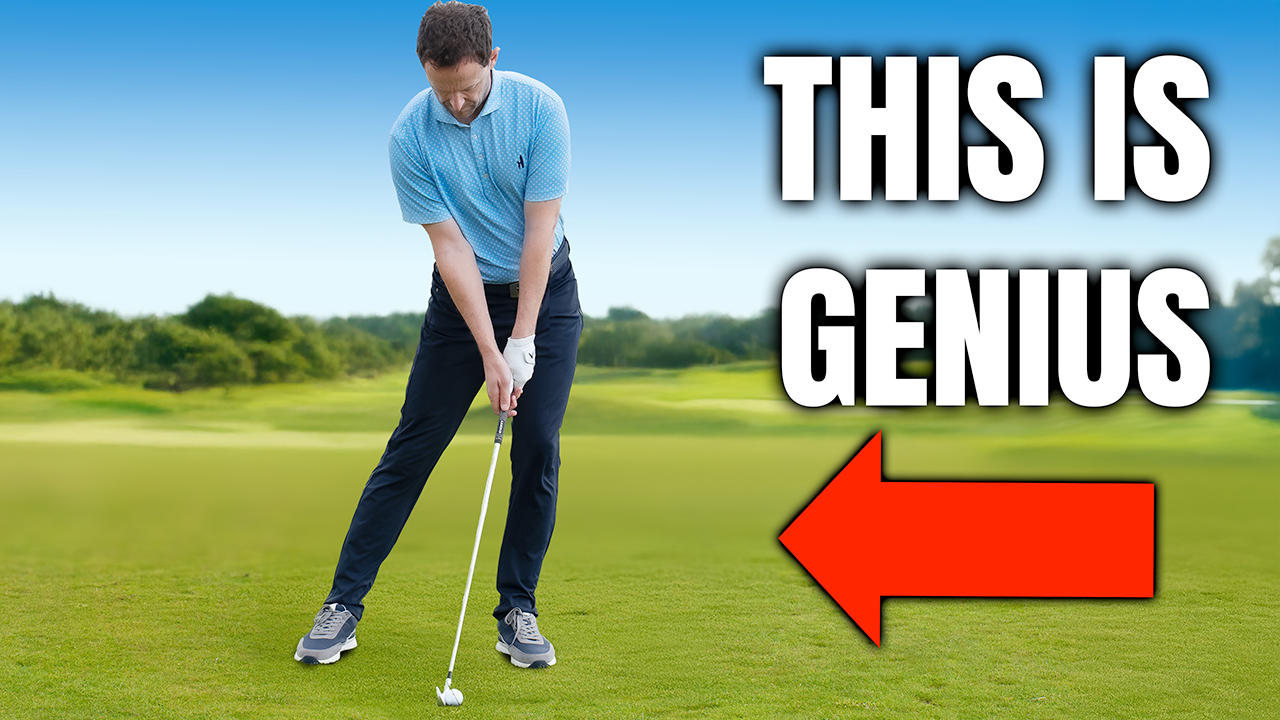
This is why you struggle to strike your irons pure and make solid contact
Jan 19, 2026 Get This Free Practice Plan
Transcript Summary-
You know when you go out on the course and it just feels so inconsistent? You hit one great shot, then a couple of really poor ones, and you just can’t seem to string it all together. That’s exactly where Damian was when he came for his first golf lesson. His bad shot was always low and right, and his contact was all over the place — really inconsistent.
Now, I know you don’t have time to sit through a full hour-long lesson, so I’m going to show you the part that completely changed Damian’s ball striking — and it can do the same for you.
When we first started, Damian was doing what most golfers do: releasing the club far too early and letting the arms buckle through impact. The golf swing works in a circle — and when your arms collapse or the release happens too soon, that circle moves up and down, leading to those fat and thin strikes.
So here’s the simple drill I gave him — and honestly, it was a game changer.
Start by moving your pelvis so it’s more over your lead heel, but keep your head right in the middle. From there, as you swing through, feel like you’re pouring water out of your right ear onto the ground. Straight away you’ll notice how your arms stay in their shape and your body naturally rotates through impact. Your hips point towards the target, your weight moves forward, and everything feels so much more connected.
It might feel strange at first — Damian said it felt completely new — but as soon as he did it, the contact was night and day. Suddenly, his low point was after the ball, just like the pros, and he was striking everything so much cleaner.
Now, this drill isn’t something you do out on the course during play. It’s there to help your body learn the right feels. Once you’ve rehearsed it enough, you can take one simple rehearsal before a shot — feel that “pouring out the right ear” motion — and then just trust it. Don’t clutter your mind with thoughts or mechanics.
As we went on, I started to shift Damian from having 90% of his weight on the lead side to about 70%. That gave him the ability to move into the shot with a bit more speed and snap — and that’s where we started adding distance without losing that solid contact.
Within minutes, his strikes were 4 inches after the ball, dead straight, and carrying over 130 yards — with very little effort.
So, if you’re struggling with consistency, start here. Focus on making solid contact first — ball then turf — before chasing extra yards. Once you can do that, then we can start layering on the power.
And if you found this helpful, give it a thumbs up, maybe share it with a friend who’s just starting out. If you want to go deeper with personalised lessons, all the details and free practice plans are at dannymaude.com.
But until next week — have a great golfing week.
Full Transcript- So tell me a little bit about um what's happening on the golf course. Real really inconsistent. Yep. I do a good shot and then I do two or three bad ones quite often. Right. It's not often I do a load of good shots in one round. Okay. Um but my bad miss is low to the right. Low to the right. And your strike, what's your strike generally like? It's as I say, it's just really inconsistent. Y. So we're going to get back to Damian's lesson in a second, but it was an hour golf lesson. I know you haven't got an hour to watch the whole live golf lesson. So, what I'm going to do is I'm going to bring you back to watch the part that made the biggest difference to his ball striking. So, you can see here Damian massively inconsistent. The reason being like a lot of players who struggle with ball striking, Damon is a beginner golfer, this is actually his first lesson. And ultimately, what he was doing is this. If you want to strike a ball well, you've got to strike the ball then the ground, right? But to do that, you don't want to be doing this. You don't want to be releasing that club early. And you want don't want to be kind of buckling these arms for impact here because you lose the consistency of the arc. The golf swing is a circle. And if these arms are starting to buckle like this, the circle moves up and down is going to massively affect your ball striking. But also it affects the release of this golf club. You can release it too early, thus losing strike and distance. What I want to do now is I want to share with you the drill that I gave Damian which was an absolute game changer for him. Now, you're going to see the first part of this lesson where all we did was want to improve his strike to get this circle hitting the ball, then the ground and stop hitting the ground behind the golf ball. So, that's what I'm going to jump in first. And then towards the end of lesson, we'll show you how we then hit the ball longer. So, you said to me, I want a golf drill, something that's going to help me, right? So, this is the simple golf tip. Take your weight at your pelvis and move it over onto your left here along line, but don't move your head. Okay? So, the head your head stays in the middle of your stance. Perfect. Right now, what I want to do is this. Okay. I want you to notice your eyes. Right. They're at this level. Yeah. Right. Then what we're going to do is this. I want you to now swing through keeping your eyes angled like you're going to pour water out of your right ear onto the ground. Swing to there. Done. What do you notice easily about your arms now? They're still in that same shape. They're still in the same shape because you've pivoted around your spine. Yeah. Where is your hips starting to point now? Towards. Yeah. Right. Yeah. So, so what you're going to do now is this. Right. Where do you feel your weight is now? Well, weight is probably more forward. Forward. Right. Now, what we're going to do is something we're going to tuck the hips. We're going to tuck those hips underneath. Right. And we're keep that head tilted down towards the ground. There you go. This is important. That's going to help you look up there. Look. Now, pause there. Hold that place for a second. Just there. Yeah. Relax. Right. He got that. Yeah. That is where we're moving to. See, I've never done that before. No. Now, watch this. I'm going to move you back now to the start. Right now, put your weight over on your over the he the middle of those that pelvis over your lead heel, but keep your head there. You go. Handle forward. Now, pour water out of your right ear as you come through. Hold that place. Don't move. How easy is to keep the arm straight? A lot easier. A lot easier, isn't it? Because your body is turning. So, the arms don't need to bend anymore. You follow? Yeah, the shoulders are moving to your arms that have to bend. Yeah. The problem is if you're trying to return to here, your body stalls, you've only got your arms, so they have to crumple. Yeah. Okay. Yeah, that does make sense. So that's, by the way, that is what we're going to do. Yeah, that's all we're going to So you now got a drill of an idea of, oh, this is my destination, right? I've got to get to that destination somewhere. So what you could do is to start with the drill is this. Push your weight forward. Pour water out of your right ear. See, I've I've never shifted my weight. No. Like that at the start. Do you do that? Is that to start my swing every time? No, no, no. This is This is a drill. So So it's a really good point to make. Right. It's a great place to start and give you a drill. I think when your body knows where it needs to get to, I often imagine it like hammering a nail into a piece of wood. Yeah. Knowing the nail has to go in that direction, it informs your body. And even if let's say somebody had an injury, right, and they their arm was like this, it wouldn't matter. They would know that that's the nails got to go in that direction. So everyone's got maybe different motions, but because we know the direction we're going on, everything follows from there. Yeah, that makes sense. Whereas now it's less, oh, okay, this is where we're going. And what you're doing is you're following the circle with your body and you're finishing there. You're pouring water out of your trail ear like this. You'll see any top player that always angle towards the ground and you go, "Okay, I just need to" And then eventually when we move back to normal, you now know, "Oh, and this is where I'm going towards." Yeah. You follow? So, pelvis over. That's it. Pour water out your right ear. Extend. Feel like you're tugging those hips underneath a little bit there. That There you go. Hold it there. Beautiful. Got it. Yeah. So, I've not done that position before. No. So, do a couple of So, one rehearsal, right? So you go one rehearsal handle as the drill as the drill. You do one rehearsal all pause that key the handle forward. There you go. Notice what that notice when you do this. Notice I see that's actually put the center of my circle naturally there, hasn't it? Beautiful. Yeah, it has. Hasn't it? So shall I hit one? Yeah. Wherever you want to do how and however you want to do it. There's no right or wrong here.
That feels so surreal. Yep.
It might feel surreal, but what do you notice now? Oh, wow. At the low point. Wow. 5 in after the ball. Wow.
And you just chipped it. So, this is the, by the way, this is the start of how you make solid contact. Yeah. I mean I mean I barely swung that either either. Yeah. Better. There you go. Come on. Now that that really feels like it's going right. Yeah, I know. So you can see here your sensations there. Look at the low point now. Look 3.9 in after the golf ball. Right. So we're starting to find ways to make solid contact. Yeah. Right. The best players in the world are around about 4 in. Right. So this is a starting point. Right. Let the drill give you the information, not you stood over the golf ball one after the other giving yourself instructions. Okay, that's what drills are purely for, right? Would that be a good idea when I'm next playing just to do that as a practice swing? Uh yeah, you if you give if you hear yourself talking to yourself, do this, do this, do this. I think that's where people go wrong. Yeah. You know, for now, we need a drill. We need the drills to teach us the sense, our own sensations, right? So the feelings that you get from that drill are going to be different to what I get from the drill, right? So once we've got the drill, the arms are nice and nice and straight and we're pivoting, whatever that is. Yeah. Go. In fact, don't even analyze it. Don't even rationalize it. Don't even put words to it. Just allow your body to go. Yes. Set it up. Am I Is my pelvis over there? Yeah. Is my head in the middle? Yes. And then just do it. Am I Am I When I'm pivoting through, I'm stopping here. My arms nice and soft but fairly straight. I'm pouring water on my right ear. These are checkpoints. Yes. Yeah. Make sense? They're check only checkpoints. Then you go back and you go just do it. But you don't overthink that. My god, that sounded different. Yeah, that sounded so different. Look at that. Look at See, look at look at the Look how dead straight it is. Yeah. Look at that strike. Wow. And we said we wanted consistency, didn't we? Yeah. Right. So, golf is no magic fix. There's a stage and a process that we take golfers through. Right. It's your first lesson, right? Yeah. We take a golfer through a process of making solid contact consistently time and time again. We teach them that how they start going achieving that. Yeah. Then we work on the next stage, distance. Yeah. Add some power to that. That one's only drawn back to here. Yeah. It feels like, doesn't it? Yeah. And and look at the difference. No. Yeah. So, this is the starting point. Yeah. Right. This is where every golfer should start if you want to be consistent at golf. Yeah. Yep. Oh my god. What a sound. What a sound. There you go. What a sound. 4.6 in after the golf ball. Now you've carried it over 100 yards comfortably. We're getting there. Yeah. Wow. Well done. Good. Great advice. Good.
Listen. Listen to that. You can hear it, can't you? Yeah. Look at that now. Dead straight. So, as you can see, Damian now has the first building block in place. He's starting to make solid contact and got some consistency there. But how do we increase his distance without losing that? Well, you do it in gentle stages. So, what we did is he started off with like almost 90% of his work on his lead side. What you're going to see in a second is I'm going to move that to about 70%. Then, what we're going to do is that gives him a bit of scope. Now, he knows his destination he needs to get to. He now can move into that destination with a bit of snap. So it's not just as we've been doing like this smoothly going through. He's now got a bit of snap. That's all we're focusing on. He and you're going to see in a second me give him a little routine that he can do on a golf course to make this work and transfer. You're going to love it. I think what would you So if if I play a game Yeah. in the next week, what would you do? What would I do then? Right. I you you can't think also those on a golf course. So I might go one drill and off I go. Yeah. And what you're doing in reality is you're hoping over time a little bit like riding a bike, you can't explain how you've learned balance. Yes. But because you've done enough of it, eventually your body gets it. Yeah. And that's what happens on the golf course. Whereas unfortunately what golfers do is they go, I've got to do this. Danny says I've got to get right ear here. I've got to get this that that you're done. You start thinking like, yeah, no, you go I'm gonna start not 90. I'm g start 70. I'm gonna do one of those drills because that's that's not that drill before. So already that's a different place. Yeah. I know my destination. Hold that finish. Right. I know this shot won't be perfect, but you know what? I'm going to make my best effort. And then on a 50/50 when I take my shot. Oh, no. I would I wouldn't go 5050. I would stay 70. 70 is still okay. Okay. That's definitely still favor your left side and then just hit it a bit shorter but gradually build that up. I think you'll be surprised. Okay. I think you'd be surprised at how far you hit it. Okay. Okay. But yeah, but I would rather you come back saying, "Do you know what, Danny? I was a little bit shorter, but you know, those douffs I were getting, I'm not getting them anymore." Yeah. Yeah. Well, that' be that would be a dream. Yeah. All right. So, it's just 70 this time. Just a bit 70. Head in the middle is down still. Rehearse.
Feel it. That's it. And away you go.
And watch this. This distance will be greater. There you go. Wow. 127. And remember, doesn't have to be stiff or anything, but increase, you know, you've got those forces. If we increase that speed, you're going to have to have some strength to bang and and stop it. Yeah. Can I do one more practice? Yeah. Yeah, of course you can. Bang. There you go. Okay.
Good hit into there. Good hit. There you go. Look at the difference. Wow. 137 yards. Dead straight as well. Dead straight. Wow. 137 yards. Dead straight. Bottom of the swing after the golf ball. So, I really hope you enjoyed that lesson. If you did, give it a thumbs up and maybe share it with a friend of yours or maybe a beginner golfer that you know who's at the same stage as Damian just wanting to improve the consistency of their ball striking. If you've got that contact down and you want to add some more distance, click this video out right here. If you're new to the channel, press the subscribe button down here. And if you'd like to receive personalized lessons from myself, head on over to dannymore.com. All details in the description box below with the free practice plan. But until next week, have a great golfing week.
