
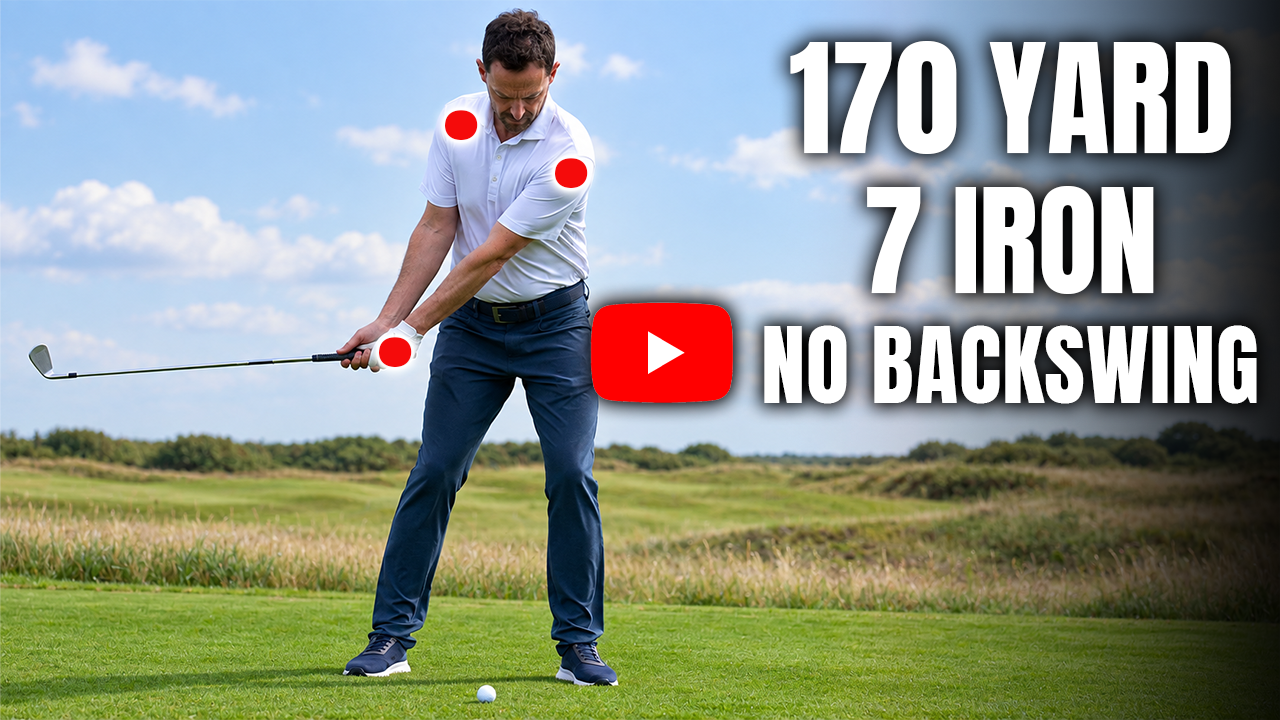
Use This Simple Golf Tip To Hit Your Irons Further
Sep 14, 2026 Get This Free Practice Plan
Transcript Summary-
A lot of golfers want to hit the ball further, but they don’t necessarily have the ability to make a longer swing, especially if they’re dealing with injuries or physical limitations. The good news is, you can create more effortless power without making your swing longer. There are two things you really need to understand: knowing your destination and learning how to accelerate the club at the right time.
The first thing is knowing where you’re trying to finish. Because we play golf with an angled club, you want your body and club to work around an angle rather than simply lunging towards the golf ball. As you swing through, your trail shoulder should be lower, your eyes and ears should be on an angle, and your lead arm should finish higher than your trail arm. Having that clear destination allows your body to organise itself naturally around the movement and helps prevent common faults like lunging forward or coming over the top.
The drill I use for this is called the “Longest Putt”, which was actually given to me by a friend, Andreas Kelley. Start with a seven iron, the ball slightly forward of centre and a little weight favouring your lead side. From there, make a very small swing and simply rehearse the finish. Don’t worry about hitting a ball initially. Get used to the feeling of your trail shoulder staying low and turning towards the target, with your body moving around an arc. It may feel strange at first because many golfers are used to keeping that trail shoulder too high.
The second part is learning to catapult the club. Golf is very much a throwing action, and you need to learn how to accelerate the club through the ball rather than simply making a bigger backswing. With the “Longest Putt”, you only swing back a short distance, but from there you imagine the club being catapulted around the corner towards your finishing position. If you struggle to feel this, turn a club upside down or use an alignment stick and listen for the whoosh. The goal is to learn to create that sound by accelerating the club through the impact area.
Once you combine those two things, you can start hitting golf balls. Begin slowly, make the small swing, and check your finish. Is your weight still forward? Is your body on an angle? Is your trail shoulder low? Once those positions start to feel natural, keep the swing the same length and gradually increase the speed of the club through impact.
What I love about this drill is that it trains you to create effortless speed without needing a huge backswing. You’re teaching your body how to support the club as it accelerates around the corner, rather than throwing your upper body towards the golf ball. Once you understand that feeling, you can gradually extend the swing naturally and take that sensation into your full iron swing, fairway woods and even your driver.
So, if you’re a shorter swinger or you simply don’t have the physical ability to make a huge golf swing, don’t assume you can’t create speed. Get really good at knowing your destination and learning how to catapult the club through impact. Practise this consistently and you can start generating much more effortless power with the swing you already have.
Full Transcript- So, a lot of my students, they want to hit the golf ball longer, but they don't have the ability to swing longer because of injuries and what have you. So, I show them this. I give them this simple drill.
And we visited that what, 170 yards with probably what you saw was a very, very tiny looking golf swing. And I said to them, there's two things that you need to be pretty good at if you want to hit the ball longer with what you have. The first thing is you need to know the destination you're going to. Right, this is really, really important to know the destination. The more you can start with the end in mind, know where you're supposed to finish, your body can organize itself very naturally and very powerfully around that. The second thing you're going to need to know is this, you need to notice how to in a sense accelerate the club at the right time. And the feeling that you need to achieve that. If you can really feel this club accelerate, or I I like to call catapulting at the right time, you can start to create this effortless looking golf and that actually hits it a little bit further than you're doing right now. Without having a longer swing. So, here's the drill. Now, this is a drill that you can I would recommend you do over and over and over again. It is not a by the way, before we start, it's not a magic fix. You don't do the drill once and you're suddenly going to be brilliant. This is a drill that is um if you do it consistently, it's tricky to start with. It can feel a bit strange. It can be tricky to get handle of, but once you get it and you repeat it over and over again, your body starts to kind of really get it and it's something you can transfer to the golf course with not just your irons, but your driver, too. So, here's how you set it up. Stage one is simply this. I get myself set up here, ball position, you know, maybe just a little bit head of center. I've got seven iron like I said, but we can apply this to driver and and your fairway woods. Put a little bit of weight, just favor that lead side just a little bit here. And from this position, and this is a drill I'd love to say that came up with myself, but I didn't. I It was a friend of mine, Andreas Kelley, that gave me this. It's called the longest putt. It's just brilliant. So, what we're going to do here is this. Stage one of this process is this. I want you to know where your destination is. We play golf with angled golf clubs. So, we need to make sure that when we're swinging through to about halfway, we are swinging on an angle. So, what I'm going to do here is this. You'll notice as I swing through here, and I'll weight on my front foot here, my trail shoulder is down at an angle. My eyes are at an angle, my ears are at an angle, and I'm finishing just like this. The other thing you'll notice here is you'll notice my lead arm here is higher than my trail arm. This is proving that I swung my body on an angle, on a circle, like this. Okay? Very important. So, knowing that you've got a destination to go to is just brilliant because your body goes, "Ah, that's what I'm going to try to achieve." You're less likely to make some of the faults I see on my uh my swing coach app where you see a lot of players that are lunging at the golf ball like this, where the shoulder stays too high, the eyes are kind of, in a sense, very level on the way through here. This leads to tops, poor strikes, loads of um loss of distance. Whereas, this really helps you to improve the quality of your strike, and naturally increase your distance. So, that's the first thing. Set up, knowing that you've got a destination. Just No backswing start. Just do some rehearsals, and just practice this sensation for for when you watch probably find this will feel strange to you because for most people, that like I said, this trail shoulder stays way too high. See this a lot in the app. Everyone lunging forward here. What I love about this is this. You're going to now feel this right shoulder turning towards the target, but from a very low position here versus most people when they swing long to start with, they're swinging from a high position. This is the over the top. So, from it, swinging from a low position. So, she's on an arc here. So, spend a bit of time just feeling that motion there. The shoulders all turning, eyes, ears all on an arc through impact, okay? That's it. Nothing more complicated than that. You're starting to kind of in a sense get that sensation. Like I said, if you do have my app, look at the app from face on. It will give you that feedback. It will tell you whether you're doing this correctly or not. The second thing now is this. And this is the thing that I would say doesn't exist in most amateur golfers. It exists in most decent players, but amateurs not. Is we've got to remember that we are Golf is very much a throwing action, right? We want to be catapulting this golf club. So, the cool thing about this drill is is it's a longest putt. We're only going to swing to around about here. Now, the reality is is everybody, including me, always swings back a little bit longer. And that's absolutely fine. But, the intent is to swing only to a short distance. Now, from here, what I want you to do, the club is behind you. I want you to imagine from here that club is going to catapult around the corner to that place. Can you hear that noise? I'm catapulting, look, to that place we've just gone to. There. There. Catapult, okay? You can use If you struggle to do this, you can use sound. Grab an alignment stick or just turn your club upside down. Here.
Hear that noise? When people do this for the first time, they can't create that noise. It looks more like this.
So, you have to learn to feel the catapult through impact, okay? These two things together will really help you sense, first of all, how your body is working beautifully and turning beautifully to catapult that club around. Now, let me show you now hitting a golf ball. So, I get myself set up here. We start slowly and we try and initially do some rehearsals, see if you can hit balls just to start with. Can you actually hit a golf ball and check your position here? So, we're going to swing, imagine we're going to finish, we know the destination here. And we do this. And we look here and we go, "Right, where am I finished?" And I go, "Yep, angle perfect, pretty good. I felt like my weight maybe have just drifted back a little bit there. I didn't quite keep it forward." These are the feelings, right? So, what you do is is you check then before you start accelerating. But once you've done a few of them and you start to find that you're swing you're striking it quite nicely and you feel like you're finishing at this angle here, then you can gradually same thing, not don't extend the length at all, see if you can start to catapult that club faster on the arc here to finish again in that place. Now, as I'm doing this, I personally feel, but these are my feelings from this drill, I feel my right shoulder is back here, nice and low, and it's accelerating that club around the corner like this in a very smooth [snorts] and effortless way. And you can see here, I have probably gone a little bit longer there, but look at how far that's gone. With a really, really small swing. So, I love this drill because it's training one of the vital parts that you need to feel. From here to here. Because you're only here, your right shoulder here, trail shoulder is already low. So, you're now training it to stay low, work here. I love that because most players, like I say, poor players are coming down from a very high right shoulder, okay? This is where a lot of problems come from. Now you know that feeling, you can then start to keep extending it so it goes to a high place naturally as far as you physically can. Now you know where it needs to get to here for it to now fire through the impact area. So it trains some great feelings, great starting points that you can use to then extend into that full swing. So you may be a short swinger, but this you can see here, you can start to generate some effortless power if you do this correctly and get your body supporting this motion. So I hope you enjoyed this video. If you did, give it a thumbs up, maybe share it with one of your friends. And if you'd like some support with your golf swing, do check out my brand new Swing Coach app which basically analyzes your golf swing, um tells you what you're doing wrong and more importantly gives you drills, simple drills like this to help you fix it whilst basically monitoring you every single swing that you do. You can check that out by just scanning the QR code right there. You've got a 14-day free trial at the moment. If you'd now like some help with your driver, if you start slicing this out and you want to know how to extend this into your driver, click this video right here. But until next week, have a wonderful golfing week.
